Archive for October, 2009

Earnings: Is That REALLY What’s Driving The DJIA Higher?

Thursday, October 22nd, 2009

By Vadim Pokhlebkin

It's corporate earnings season again, and everywhere you turn, analysts talk about the influence of earnings on the broad stock market: 

  • US Stocks Surge On Data, 3Q Earnings From JPMorgan, Intel (Wall Street Journal)
  • Stocks Open Down on J&J Earnings (Washington Post)
  • European Stocks Surge; US Earnings Lift Mood (Wall Street Journal)

With so much emphasis on earnings, this may come as a shock: The idea of earnings driving the broad stock market is a myth.

When making a statement like that, you'd better have proof. Robert Prechter, EWI's founder and CEO, presented some of it in his 1999 Wave Principle of Human Social Behavior (excerpt; italics added):

Are stocks driven by corporate earnings? In June 1991, The Wall Street Journal reported on a study by Goldman Sachs’s Barrie Wigmore, who found that “only 35% of stock price growth [in the 1980s] can be attributed to earnings and interest rates.” Wigmore concludes that all the rest is due simply to changing social attitudes toward holding stocks. Says the Journal, “[This] may have just blown a hole through this most cherished of Wall Street convictions.”

What about simply the trend of earnings vs. the stock market? Well, since 1932, corporate profits have been down in 19 years. The Dow rose in 14 of those years. In 1973-74, the Dow fell 46% while earnings rose 47%. 12-month earnings peaked at the bear market low. Earnings do not drive stocks. 

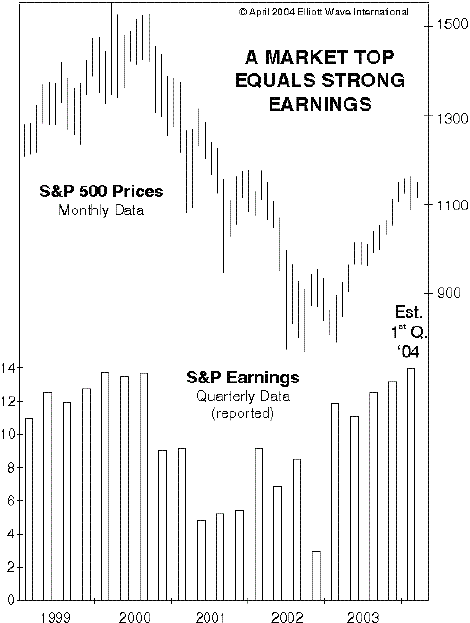
And in 2004, EWI's monthly Elliott Wave Financial Forecast added this chart and comment:

Earnings don’t drive stock prices. We’ve said it a thousand times and showed the history that proves the point time and again. But that’s not to say earnings don’t matter. When earnings give investors a rising sense of confidence, they can be a powerful backdrop for a downturn in stock prices. This was certainly true in 2000, as the chart shows. Peak earnings coincided with the stock market’s all-time high and stayed strong right through the third quarter before finally succumbing to the bear market in stock prices. Investors who bought stocks based on strong earnings (and the trend of higher earnings) got killed.  

So if earnings don't drive the stock market's broad trend, what does? The Elliott Wave Principle says that what shapes stock market trends is how investors collectively feel about the future. Investors' mood — or social mood — changes before "the fundamentals" reflect that change, which is why trying to predict the markets by following the earnings reports and other "fundamentals" will often leave you puzzled. The chart above makes that clear.

Get Your FREE 8-Lesson "Conquer the Crash Collection" Now! You'll get valuable lessons on what to do with your pension plan, what to do if you run a business, how to handle calling in loans and paying off debt and so much more. Learn more and get your free 8 lessons here.


Robert Prechter, Chartered Market Technician, is the world’s foremost expert on and proponent of the deflationary scenario. Prechter is the founder and CEO of Elliott Wave International, author of Wall Street best-sellers Conquer the Crash and Elliott Wave Principle and editor of The Elliott Wave Theorist monthly market letter since 1979.


How to Prepare for the Coming Crash and Preserve Your Wealth

Wednesday, October 14th, 2009

Bob Prechter first released Conquer the Crash: You Can Survive and Prosper in a Deflationary Depression during a stock-market high in 2002, and it quickly became a New York Times–bestseller. Now he has updated the book with 188 new pages for a second edition, and it looks like it, too, will be published near a stock-market high. John Wiley & Sons plans to publish the new edition in late October. Visit Elliott Wave International for information on how to pre-order the new edition from major online retailers. 

As was widely reported in the dark days of late February and early March 2009, Prechter called for the start of the biggest stock market rally since the 2007 high. Since then, the S&P has soared more than 60 percent in just six months to reach his target zone of 1000-1100. This is one reason why he decided to release his second edition now.
The first edition, which was published in early 2002, was "on the mark" with regard to our current economic environment — so much so that it's uncanny. Prechter’s message has been good for investors who kept their money safe and for speculators who profited from declines. And he still expects a great buying opportunity ahead for those who can keep their money safe until it arrives. Here is a short list of some of the accurate predictions he made in 2002 that have come to fruition:

Credit Deflation

"Usually the culprit behind [simultaneous stock and real estate] declines is a credit deflation. If there were ever a time we were poised for such a decline, it is now." Chapter 16

Bailout Schemes

“If [governments] leap unwisely into bailout schemes, they will risk damaging the integrity of their own debt, triggering a fall in its price. Either way … deflation will put the brakes on their actions.” Chapter 32

Banking and Insurance Stocks

“We will see stocks going down 90 percent and more … [and] bank and insurance company failures….” Chapter 14

Collateralized Securities

"Banks and mortgage companies … have issued $6 trillion worth of [securitized loans]….  In a major economic downturn, this credit structure will implode." Chapter 19

Derivatives

“Leveraged derivatives pose one of the greatest risks to banks….” Chapter 19

Mortgage-Backed Securities

"Major financial institutions actually invest in huge packages of … mortgages, an investment that they and their clients (which may include you) will surely regret…. Chapter 16

Fannie Mae and Freddie Mac

“Investors in these companies’ stocks and bonds will be just as surprised when [Fannie and Freddie's] stock prices and bond ratings collapse.” Chapter 25

Banks

“Banks are not just lent to the hilt, they’re past it. In a fearful market, liquidity even on these so called ‘securities’ [corporate, municipal, and mortgage-backed bonds] will dry up.”… One expert advises, ‘The larger, more diversified banks at this point are the safer place to be.' That assertion will surely be severely tested….” Chapter 19

Insurance Companies
“The values of insurance company holdings, from stocks to bonds to real estate (and probably including junk bonds as well), will be falling precipitously…. As the values of most investments fall, the value of insurance companies’ portfolios will fall…. When insurance companies implode, they file for bankruptcy…." Chapters 15, 24

Real Estate

"What screams 'bubble' – giant, historic bubble – in real estate today is the system-wide extension of massive amounts of credit to finance property purchases…. [People] have been taking out home equity loans so they can buy stocks and TVs and cars…. This widespread practice is brewing a terrible disaster.” Chapter 16

Rating Services

“Most rating services will not see it coming.” Chapter 25

Political Leaders
“A leader does not control his country’s economy, but the economy mightily controls his image.” Chapter 27

Short-Selling Ban

“In a bear market, bullish investors always come to believe that short sellers are 'driving the market down'…. Sometimes authorities outlaw short selling. In doing so, they remove the one class of investors that must buy.” Chapter 20

Psychological Change
“When the social mood trend changes from optimism to pessimism, creditors, debtors, producers and consumers change their primary orientation from expansion to conservation….” Chapter 9

Confidence

“Confidence has probably reached its limit. A multi-decade deceleration in the U.S. economy … will soon stress debtors’ ability to pay…. Total credit will contract, so bank deposits will contract, so the supply of money will contract….” Chapter 11

Falling Tax Receipts
"Governments … spend and borrow throughout the good times and find themselves strapped in bad times, when tax receipts fall." Chapter 32

"Retirement programs such as Social Security in the U.S. are wealth-transfer schemes, not funded insurance, so they rely upon the government’s tax receipts. Likewise, Medicaid is a federally subsidized state-funded health insurance program, and as such, it relies upon transfers of states’ tax receipts. When people’s earnings collapse in a depression, so does the amount of taxes paid, which forces the value of wealth transfers downward." Chapter 32

"The tax receipts that pay for roads, police and jails, fire departments, trash pickup, emergency (911) monitoring, water systems and so on will fall to such low levels that services will be restricted." Chapter 32

For more information on the new second edition of Conquer the Crash, visit Elliott Wave International. Bob Prechter has added 188 new pages of critical information to his New York Times bestseller.


Susan C. Walker writes for Elliott Wave International, a market forecasting and technical analysis company.


Q&A With Robert Prechter: Why Technical Analysis Beats Out Fundamental Analysis

Monday, October 5th, 2009

By Elliott Wave International

As the major stock markets turned down in late 2007 and then started to rally in March 2009, many people who believed in fundamental analysis have begun to question its validity.

Famed technical analyst and Elliott wave expert Robert Prechter has long called for the bear market we are now in the midst of. (He views the rally of 2009 to be a bear-market rally not the beginning of a new bull market.) But over the years, his methods of technical analysis have been criticized. Here are his most succinct arguments as to why wave analysis outdoes competing forms of analysis.

Learn the Wave Principle and Other Forms of Technical Analysis. Elliott Wave International has just released The Ultimate Technical Analysis Handbook. This FREE 50-page ebook is dedicated solely to teaching reformed fundamentals followers to incorporate technical analysis into their own investing decisions. Learn more and download your free copy here.

*****
Excerpted from Prechter's Perspective, re-issued 2004

Question: Suppose everyone agreed, "The Wave Principle is not always right, but it really is the answer"?

Robert Prechter: Well, let me begin my answer with a quote from a national financial magazine dated October 1977. "Over the last few years, the Wave Principle has gathered too much of a following and, therefore, it has less value today. Almost invariably, you can write off a technique when it gets too much of a following." How does this statement look in light of the decade that followed it? "Elliott" had one of its greatest successes. Like the Energizer Bunny, it keeps going and going. And I believe its next success will be its biggest ever. The Principle itself is undoubtedly on an upward spiral of acceptance: three steps forward and two steps back.

Now let's suppose that a large number of educated people accepted the Wave Principle, which is not an impossible idea for, say, a thousand years from now. There would still be room for differences of opinion on the market and the future. And there are countless other factors. Even people who practice the craft don't necessarily take action when they get a signal. Unconscious doubt and worry often foil people's actions. Very few traders have the emotional strength to turn even good analysis into profits.

Q: The Wave Principle is intrinsically contrarian. Does it have some built-in defense against becoming the consensus?

RP: I think so. The Wave Principle is a description of natural human behavior. This is what human beings are; this is part of their nature — how they behave. In order for markets to continue to go through these stages, a part of human nature must be to believe that such theories of mass psychology are incapable of being true — that is, something not worth examining. They must be primed to accept bullish arguments at tops and bearish arguments at bottoms. That means they have to be ever open to bogus theories of market behavior. How else will they create the patterns that fear, greed and hope produce?

Q:  How big is the pool of analysts who rely on the Wave Principle?

RP: I think there are quite a few people who are proficient in applying Elliott to past and present markets, say, perhaps 1% of all technical analysts, which is a pretty good number of people, I suppose. A lot of those are my subscribers, and they learned it through studying the Theorist. However, as far as the number of people proficient at applying the Wave Principle for forecasting market turns, which is significantly more difficult than applying it in real time, I think there are very few.

Q: This has been the basis of some criticism. To quote one critic, "relying on arcane methods does have one advantage. Interpreting the linear squiggles is left in the hands of the major heir to Elliott's work." How do you respond to those who contend that the complexity of the theory is a cover that allows you to retain the Wave Principle as your personal theory?

RP:  With regard to any supposed self-serving secrecy, not only did I co-author a book on how to apply the Wave Principle, as well as reprint Elliott's writings against protest from practitioners, but also I continually go into great — some might say excruciating — detail in each issue of The Elliott Wave Theorist explaining exactly what I think the market has done and will do, and why I think it. If there is any market letter that has educated potential competitors, it is mine. The reason is that the study of markets is more important to me than exclusivity, secrecy or power.

Q: Another common approach critics take when they try to dismiss Elliott as bunk is to refer to you as a mystic or a numerologist.

RP:  A mystic believe in things for which there is no evidence, only desire. I do not consider myself to be a mystic at all. My approach is objective. The empirical basis of Elliott's discovery speaks to that fact. So do the results of the trading competition [Editor's note: Bob Prechter won the Trading Championship in options in 1984 with a stunning 444% gain. The next closest competitor showed an 84% gain.] Not once during any month since the independent rating services have been following market timers has a timer using a numerological approach such as "Gann" analysis ever placed in the top 10 rankings. Just as would be expected, such methods don't work!

The true mystics are those who believe, for instance, that current economic performance is a basis upon which to predict stock market prices. There is no evidence for it. They just feel comfortable with the idea, so they espouse it.

Q: So you say that the challenge to validity is on the other side?

RP:  You're darn right, it is. I am no longer at the point where I feel that I have to justify the objectivity of the Wave Principle. I think the results have done that. Technical analysis is entirely rational and has proved itself. If someone goes back and looks at the record of Elliott wave writers over the decades, he will find a track record of forecasting success that is well beyond a random result of chance. If you can do that, the ball is in the other guy's court. It's up to him to show that this is luck or something. What's more, the only challenge to a theory is a better theory, and I haven't seen a contender yet.

Q: You don't feel that you have been effectively challenged by any fundamental approaches?

RP:  I think there's a place for fundamental analysis of individual companies, but I am firmly convinced that you can make a very rational argument showing that fundamental analysis applied to overall market timing is like reading the entrails of goats. In fact, I presented such a critique in The Wave Principle of Human Social Behavior. If you think my ideas as presented here are controversial, just read Chapter 19 of that book.

Learn the Wave Principle and Other Forms of Technical Analysis. Elliott Wave International has just released The Ultimate Technical Analysis Handbook. This FREE 50-page ebook is dedicated solely to teaching reformed fundamentals followers to incorporate technical analysis into their own investing decisions. Learn more and download your free copy here.


Robert Prechter, Chartered Market Technician, is the world’s foremost expert on and proponent of the deflationary scenario. Prechter is the founder and CEO of Elliott Wave International, author of Wall Street best-sellers Conquer the Crash and Elliott Wave Principle and editor of The Elliott Wave Theorist monthly market letter since 1979.