Archive for February, 2010
Friday, February 26th, 2010
The following article is an excerpt from Elliott Wave International's free Club EWI resource, "The Guide to Understanding Deflation. Robert Prechter's Most Important Writings on Deflation."
The Primary Precondition of Deflation Deflation requires a precondition: a major societal buildup in the extension of credit. Bank credit and Elliott wave expert Hamilton Bolton, in a 1957 letter, summarized his observations this way: "In reading a history of major depressions in the U.S. from 1830 on, I was impressed with the following: (a) All were set off by a deflation of excess credit. This was the one factor in common."
"The Fed Will Stop Deflation" I am tired of hearing people insist that the Fed can expand credit all it wants. Sometimes an analogy clarifies a subject, so let’s try one.
It may sound crazy, but suppose the government were to decide that the health of the nation depends upon producing Jaguar automobiles and providing them to as many people as possible. To facilitate that goal, it begins operating Jaguar plants all over the country, subsidizing production with tax money. To everyone’s delight, it offers these luxury cars for sale at 50 percent off the old price. People flock to the showrooms and buy. Later, sales slow down, so the government cuts the price in half again. More people rush in and buy. Sales again slow, so it lowers the price to $900 each. People return to the stores to buy two or three, or half a dozen. Why not? Look how cheap they are! Buyers give Jaguars to their kids and park an extra one on the lawn. Finally, the country is awash in Jaguars. Alas, sales slow again, and the government panics. It must move more Jaguars, or, according to its theory — ironically now made fact — the economy will recede. People are working three days a week just to pay their taxes so the government can keep producing more Jaguars. If Jaguars stop moving, the economy will stop. So the government begins giving Jaguars away. A few more cars move out of the showrooms, but then it ends. Nobody wants any more Jaguars. They don’t care if they’re free. They can’t find a use for them. Production of Jaguars ceases. It takes years to work through the overhanging supply of Jaguars. Tax collections collapse, the factories close, and unemployment soars. The economy is wrecked. People can’t afford to buy gasoline, so many of the Jaguars rust away to worthlessness. The number of Jaguars — at best — returns to the level it was before the program began.
The same thing can happen with credit.
It may sound crazy, but suppose the government were to decide that the health of the nation depends upon producing credit and providing it to as many people as possible. To facilitate that goal, it begins operating credit-production plants all over the country, called Federal Reserve Banks. To everyone’s delight, these banks offer the credit for sale at below market rates. People flock to the banks and buy. Later, sales slow down, so the banks cut the price again. More people rush in and buy. Sales again slow, so they lower the price to one percent. People return to the banks to buy even more credit. Why not? Look how cheap it is! Borrowers use credit to buy houses, boats and an extra Jaguar to park out on the lawn. Finally, the country is awash in credit. Alas, sales slow again, and the banks panic. They must move more credit, or, according to its theory — ironically now made fact — the economy will recede. People are working three days a week just to pay the interest on their debt to the banks so the banks can keep offering more credit. If credit stops moving, the economy will stop. So the banks begin giving credit away, at zero percent interest. A few more loans move through the tellers’ windows, but then it ends. Nobody wants any more credit. They don’t care if it’s free. They can’t find a use for it. Production of credit ceases. It takes years to work through the overhanging supply of credit. Interest payments collapse, banks close, and unemployment soars. The economy is wrecked. People can’t afford to pay interest on their debts, so many bonds deteriorate to worthlessness. The value of credit — at best — returns to the level it was before the program began.
Jaguars, anyone?
Elliott Wave International (EWI) is the world’s largest market forecasting firm. EWI’s 20-plus analysts provide around-the-clock forecasts of every major market in the world via the internet and proprietary web systems like Reuters and Bloomberg. EWI’s educational services include conferences, workshops, webinars, video tapes, special reports, books and one of the internet’s richest free content programs, Club EWI.
Posted in Economy | No Comments »
Thursday, February 25th, 2010
By Editorial Staff
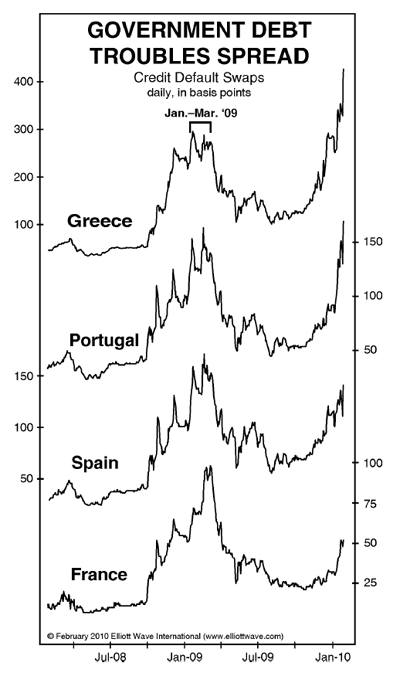
Government debt is no longer just a problem for emerging countries. Portugal, Spain, France and Greece (as we have seen in recent weeks) are living in fear of credit default. Consequently, the value of their credit default swaps is skyrocketing.
The following is an excerpt from the February issue of Global Market Perspective. For a limited time, you can visit Elliott Wave International to download the rest of the 100+ page issue free.
High levels of global debt are both financially debilitating and deflationary because they commit scarce cash to servicing interest payments. Up until now, most sovereign credit defaults occurred in emerging-market countries, such as Argentina and Russia. The deflationary tide, however, is starting to lap up against more developed Eurozone economies.
The chart shows the value of credit default swaps — an instrument similar to an insurance contract that pays holders (if they are lucky) in the event of default — for Greece, Portugal, Spain and France. In recent weeks these contracts have soared, with credit-default swaps on Greece’s and Portugal’s debt already surpassing the January-March 2009 extremes established in the latter part of Primary degree 1 down.

Obviously, the market is growing more skeptical that Greece can pay its debts, so the cost of protecting against default is rising fast. Greece’s budget deficit is 12.7% of gross domestic product, and Portugal faces a budget shortfall that’s more than twice the European Union’s limit. Traders are now buying default protection on sovereign debt at a rate of more than five times that of specific company bonds. “Greece’s neighbors would ‘step in’ to prevent a debt default to avoid ‘a problem for the whole of Europe,’” a Tokyo-based bondsalesman says. Maybe so, but who will step in to bail out Portugal, Spain, the next sovereign default or the one thereafter?
The world is running out of money to service its mounting debts, and this chart simply depicts the front edge of the next great wave of credit contraction, which will sweep into more established countries throughout Europe and eventually to the United States.
Elliott Wave International (EWI) is the world’s largest market forecasting firm. EWI’s 20-plus analysts provide around-the-clock forecasts of every major market in the world via the internet and proprietary web systems like Reuters and Bloomberg. EWI’s educational services include conferences, workshops, webinars, video tapes, special reports, books and one of the internet’s richest free content programs, Club EWI.
Posted in Economy | No Comments »
Monday, February 22nd, 2010
By Editorial Staff
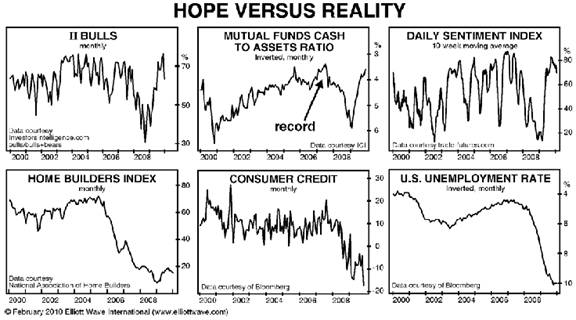
Investor expectations are decidely bullish right now, and many people expect an economic turnaround this year. What do the underlying economic conditions suggest? The Chinese mall "The Place" demonstrates the contrast between investor hope and economic reality.
The following is an excerpt from the February issue of Global Market Perspective. For a limited time, you can visit Elliott Wave International to download the rest of the 100+ page issue free.
Bullish expectations (shown by the top three panels) may not be quite as extreme as they were in 2007, but adjusted for underlying economic conditions (bottom panels), the current psychology probably ranks right up there with the most complacent outlook in history. The charts of housing, consumer credit and unemployment show the systemically sluggish state of the economy. We know that fundamentals always lag psychological trends, but the lag is generally only a matter of months. It’s been nearly 11 months since the outset of the Primary wave 2 rally; by these critical economic measures the rebound is barely registering.The wide disparity between the hope of investor expectations and the reality of economic strength shows that the great bear market — already ten years old — remains in its early stages. As the next legdown matures, hope will turn to despair, and it will become impossible to ignore the persistence of the economic contraction.

The same chasm between fundamental performance and stock market expectations is visible in other parts of the world. In China, for instance, ground reports reveal how out-of-whack financial expectations are with street-level demand. A blog called The Peking Duck described Beijing’s “stunningly dysfunctional, catastrophic mall, The Place. Fifty percent of the eateries in the basement were boarded up. The cheap food court, too, was gone, covered up with ugly blue boarding, making the basement especially grim and dreary. There is simply too much stuff, too many stores and no buyers.” The world’s largest mall in southern China is completely empty. Most investors do not see past the performance of the Shenzhen or Shanghai stock indexes, just as most of the buying and selling of U.S. stock indexes remains detached from the real economy. We see lots of hope but no change in the reality.
Elliott Wave International (EWI) is the world’s largest market forecasting firm. EWI’s 20-plus analysts provide around-the-clock forecasts of every major market in the world via the internet and proprietary web systems like Reuters and Bloomberg. EWI’s educational services include conferences, workshops, webinars, video tapes, special reports, books and one of the internet’s richest free content programs, Club EWI.
Posted in Economy | No Comments »
Friday, February 19th, 2010
By Editorial Staff
Over 100 banks are opening soon, buying junk bonds is gaining popularity and emerging markets are the trendy investment. Sound familiar? Europe appears to be returning to some bad investment habits.
The following is an excerpt from the February issue of Global Market Perspective. For a limited time, you can visit Elliott Wave International to download the rest of the 100+ page issue free.
Just as in 2007, huge bullishness in concert with no fear is cropping up. Central and Eastern European (CEE) debt markets, for example, are clearly back on investors’ radar. UniCredit of Italy plans to open 100 banks across the region, while Erste Bank of Austria is preparing 70 more in Romania. Raiffeisen International, also of Austria, is getting ready to launch an internet-based banking system to serve the region as well.
Likewise, the European junk bond market, which effectively died after the financial crisis, has bounced back to life along with the rally. At 70%, total returns on western European junk bonds were more than double those on the FTSE All Share Index in 2009. Moreover, the trend is accelerating. The week of January 11 was the second largest week ever seen in European junk bonds, according to the Financial Times, as companies sold $11.7 billion worth of high-yield debt. Predictably, bankers are ramping up their expectations for 2010. Experts forecast about €50 billion in new issuance in the coming year, a number that nearly doubles what the market has produced in its best years. Says one portfolio manager discussing the market: A “virtuous-circle effect” will take place in 2010. “There was a time when German companies, for example, would think it was a social insult to be a junk bond, but now you are seeing [them] use the market as a mainstream tool for financing."
That’s on the corporate side. On the sovereign side, shaky debtors and giddy investors are also fully recommitted. For the first time ever, Moody’s upgraded JP Morgan’s Emerging Market Sovereign Bond Index from “junk” to “investment grade.” January’s upgrade occurred in spite of the sovereign default risk growing in countries like Greece, Spain, and Italy (see Secondary Markets), but that’s not stopping yield-starved investors from buying.
Barings Asset Management and HSBC are reportedly increasing their exposure to emerging markets. So is bond giant, Pimco, which calls emerging-market debt an “asset class on the upward path.” Its portrayal, however, merely describes the last 10 months of market action. The index shown on the previous page tracks emerging-market bond yields in their local currency. Just like trader sentiment numbers, yields are firmly back to pre-crisis levels. But extrapolating the last 10 months forward may be one of the most dangerous bets around. When the financial community recklessly returns to play with the loaded firearms from the prior mania, it’s a tell that a bear-market rally is ending. Most will again shoot themselves in the foot.
Read the rest of this issue now free! You'll get 100+ pages of insights about:
- World Stock Markets
- Global Interest Rates
- International Currency Relationships
- Metals and Energy
- Social Trends and Observations
- More
Visit Elliott Wave International to download your free 100+ page issue.
Elliott Wave International (EWI) is the world’s largest market forecasting firm. EWI’s 20-plus analysts provide around-the-clock forecasts of every major market in the world via the internet and proprietary web systems like Reuters and Bloomberg. EWI’s educational services include conferences, workshops, webinars, video tapes, special reports, books and one of the internet’s richest free content programs, Club EWI.
Posted in Economy | No Comments »
Thursday, February 11th, 2010
By Editorial Staff
The following is an excerpt from a classic issue of Robert Prechter's Elliott Wave Theorist. For a limited time, you can visit Elliott Wave International to download the rest of the 10-page issue free.
Market Herding Have you ever watched a dog interact with its owner? The dog repeatedly looks at the owner, taking cues constantly. The owner is the leader, and the dog is a pack animal alert for every cue of what the owner wants it to do. Participants in the stock market are doing something similar. They constantly watch their fellows, alert for every clue of what they will do next. The difference is that there is no leader. The crowd is the perceived leader, but it comprises nothing but followers. When there is no leader to set the course, the herd cues only off itself, making the mood of the herd the only factor directing its actions.
Irony and Paradox To anyone not versed in socionomics, everything the stock market does is saturated with paradox.
— When T-bills sported double-digit interest rates in 1979-1984, investors saw no reason to abandon their T-bills for stocks; when T-bill rates were low in the 2000s, investors saw no reason to put up with the “low yield” of T-bills and sought capital gains in stocks. The first period was the greatest stock-buying opportunity in two generations, and the second period was the greatest stock-selling opportunity ever.
— When long-term bonds yielded 15 percent in 1981, investors were afraid of Treasury bonds even though they were about to embark on the greatest bull market ever; in December 2008, when the Fed pledged to buy T-bonds, rising prices appeared so strongly guaranteed that the Daily Sentiment Index indicated a record 99 percent bulls, just before prices started to fall.
— When oil was $10.35 a barrel in 1998, no one made a case that the world was running out of black gold; but when it was 7-8 times more expensive, some three dozen books came out arguing that global oil production had peaked, a theme that convinced investors to begin buying oil futures…about a year before the price collapsed 78 percent.
— In the second half of the 1990s, the idea that stocks would always be the best investment “in the long run” became popular just as a long period of superior returns was coming to an ignoble end. A new study… shows that as of today the S&P has underperformed safe, boring Treasury bonds for the past 40 years, since 1969.
— Just when nearly everyone — including world-famous investors — finally panicked and conceded in February-March 2009 that the financial and economic worlds were in dire shape, the market turned around and shot upward in its fastest rally in 76 years.
And so on. The exogenous-cause model fools investors exquisitely. One reason is that rationalization follows upon mood change. Mood change comes first, and attempts at reasoning come afterward. Socionomists recognize that social mood is primary and has consequences in social action, so we never have to wrestle with paradox. This orientation does not mean that we are always right. It means only that we are not doomed to be chronically wrong.
To succeed in the market, you must learn initially to embrace irony and paradox, at least as humans are unconsciously wired to interpret things. Once you get used to the world of socionomic causality, the irony and paradox melt away, and everything makes perfect sense…
Read the rest of this classic Elliott Wave Theorist issue now, free! You’ll get 10 pages of Bob Prechter's unique insights on:
- Why Finance and Macroeconomics Are Not Subsets of Economics
- How Correct Are Economists Who Forecast Macroeconomic Trends?
- The “Beat the Market” Fallacy
- Stock-Picking Geniuses or Just a Bull Market?
- Index Funds and Diversification
- Market Confidence vs. Certainty
- Observations on Corporate Earnings
- Why Being a Bear Doesn't Equal "Doom & Gloom"
- More
Visit Elliott Wave International to download your free 10-page issue.
By Nico Isaac
In case you were hiding out Tiger Woods' style far away from the mainstream media during the past month, let me be the first to say: January saw an abrupt end to the U.S. stock market's record-setting winning streak. Last count, the Dow Jones Industrial Average plummeted 4% in its worst monthly loss in a year.
And, according to one Feb. 1, 2010, MarketWatch story, "The time to consider an exit strategy" has officially arrived. Here, the article captures the public's astonishment turned acceptance of the Dow's boom-to-gloom shift:
"The Dow has shocked the bulls out of their complacency. After all, analysts were looking for the bull market to last until at least the second half of the year. Investors were not prepared for such a sharp decline and now at least some of the chatter has gone from 'how high will the market go?' to 'how low will it fall?' [emphasis added]" Let me get this straight. The powers that be say it's time to "consider an exit strategy" — AFTER the Dow has already plunged 700-plus points to land at its lowest level in two months. That's about as helpful as building a life raft AFTER your ship has begun to sink.
Let me get this straight. The powers that be say it's time to "consider an exit strategy" — AFTER the Dow has already plunged 700-plus points to land at its lowest level in two months. That's about as helpful as building a life raft AFTER your ship has begun to sink.
Get a FREE 10-Lesson Tutorial on the Basics of the Wave Principle The Wave Principle is a powerful tool when used properly. This free tutorial gives you the foundation you need to put the power of Elliott to work for you. Learn more, and get your free 10-lesson tutorial here.
Then, those same sources go on to say investors were "not prepared" for the degree and depth of the stock market's decline. This is only partly true. On Main Street, the early January flood of bull-is-back-type headlines gushed in and washed all the bears away.
Yet, on our "Elliott wave" Street, preparation for a "sharp" decline in the Dow was fast in place. One week before the market turned down from its Jan. 19 high, Elliott Wave International's Short TermUpdate went on high bearish alert with this commanding insight:
"The Dow's diagonal remains in tact and its form is clear. We will afford the pattern a bit of leeway over the next one-two days… but the structure is very late in development. That means a trend reversal is fast approaching. A potential stopping range is 10,725-10,740. A close beneath [critical support] will confirm that the diagonal is over and the market has started a down phase that should draw prices significantly lower. Once a diagonal is complete, prices swiftly retrace to near its origin, which in this case is 10,263.90, the very first downside target." (Jan. 13 Short Term Update)
Soon after, the Dow peaked within four ticks of our cited upside target; next, it went on to fulfill the second part of its Elliott wave script with a staggering triple-digit slide to "near the origin" of the diagonal triangle pattern, and then some.
That leaves one question: Are the bears now ready to relinquish control of stocks? Don't wait for the market action to "shock" you.
Get a FREE 10-Lesson Tutorial on the Basics of the Wave Principle The first thing you should know is that the Wave Principle is not a black-box trading system. Elliott waves provide a context for past and present price action. Once you identify to the most likely structure of the pattern unfolding, you can then formulate a forecast for the future. The Wave Principle is a powerful tool when used properly. This free tutorial gives you the foundation you need to put the power of Elliott to work for you. Learn more, and get your free 10-lesson tutorial here.
Nico Isaac writes for Elliott Wave International, a market forecasting and technical analysis firm.
Posted in Stock Market | No Comments »
Friday, February 5th, 2010
By Vadim Pokhlebkin
Today, the EUR/USD stands well below its November peak of $1.51. Find out what
Elliott wave patterns are suggesting for the trend ahead now — FREE.
You can access EWI’s intraday and end-of-day Forex forecasts right now
through next Wednesday, February 10. This unique free opportunity only lasts a
short time, so don't delay!
Learn more about EWIs FreeWeek here.
What moves currency markets? "The news" is how most forex traders would
undoubtedly answer. Economic, political, you name it — events around the world
are almost universally believed to shape trends in currencies.
A January 14 news story, for example, was high up on the roster of events that
supposedly have a major impact on the euro-dollar exchange rate. That morning,
the European Central Bank announced it was leaving the "interest rate unchanged
at the record low of 1% for an eighth successive month." (FT.com)
The euro fell against the U.S. dollar after the news. But could it have rallied
instead? You bet. In fact, traditional forex analysis says it should have.
Here's why.
Analysts always say that the higher a country's interest rates, the more
attractive its assets are to foreign investors — and, in turn, the stronger its
currency. Well, U.S. interest rates are now at 0-.25% and in Europe, at 1%, they
are 3 to 4 times higher. Isn't that wildly bullish for the EUR?
Apparently not, and wait till you hear why — because in today's announcement
ECB president Jean-Claude Trichet warned that European recovery would be
“bumpy.” Ha!
By no means is this the first time a supposedly bullish event failed to lift the
market. On June 6, 2007, for example, the ECB raised interest rates. Bullish,
right? But the euro didn't gain that day, either — the U.S. dollar did.
Watch forex markets with these "inconsistencies" in mind and you'll see them
often. In time you realize that it's not news that creates market trends — it's
how traders interpret the news. That's a subtle — but hugely
important — distinction.
So the real question becomes: What determines how traders interpret the news?
The Elliott Wave Principle answers that question head-on: social mood — i.e.,
how they collectively feel. Currency traders in a bullish mood
disregard bad news and buy, leaving it to analysts to "explain" why.
Bearishly-biased traders find "reasons" to sell even after the rosiest of
economic reports.
If you know traders' bias, you know the trend. How do you know? Watch Elliott
wave patterns in forex charts - it's reflected in there, on all time frames.
Today, the EUR/USD stands well below its November peak of $1.51. Find out what
Elliott wave patterns are suggesting for the trend ahead now — FREE.
You can access EWI’s intraday and end-of-day Forex forecasts right now
through next Wednesday, February 10. This unique free opportunity only lasts a
short time, so don't delay!
Learn more about EWIs FreeWeek here.
Vadim Pokhlebkin joined Robert Prechter's Elliott
Wave International in 1998. A Moscow, Russia, native, Vadim has a Bachelor's in
Business from Bryan College, where he got his first introduction to the ideas of
free market and investors' irrational collective behavior. Vadim's articles
focus on the application of the Wave Principle in real-time market trading, as
well as on dispersing investment myths through understanding of what really
drives people's collective investment decisions.
Posted in Forex, Stock Market | No Comments »
|