Archive for the ‘Economy’ Category

What moves the stock market?

Monday, January 16th, 2012

The widespread idea is that events around the world direct the financial markets. We are told to believe that the market reacts to the news and people’s mood changes accordingly. When the news are good, people feel good and they buy stocks they say. When the news are bad, people sell stocks according to the orthodox view. But is that really so? What if it was the other way around? What if the mood changed first and it’s economic, political and social effects became apparent later? Could it be possible? If not, why can’t the news editors trade the markets get rich? Would you get rich if you knew the news ahead of everyone else? If you are Rothschild, maybe. But for the rest of us, it is not so clear cut.

History’s Hidden Engine

Part 1 - Presumed cause and effect relationship goes like this: War, prosperity, civil protest dictates society’s social mood. A strong economy, good leaders, rising stock market creates positive social mood. Adversely, inept leaders, bad economy, unemployment, declining markets create negative social mood. We will now start to look into this entrenched belief. What if the change in social mood was the cause of the rest? The part 1 of this series of videos talks about the correlation between stock prices and the rest of the social events such as pop culture, clothing, music, movies. Certain social trends become apparent at stock market tops and bottoms.

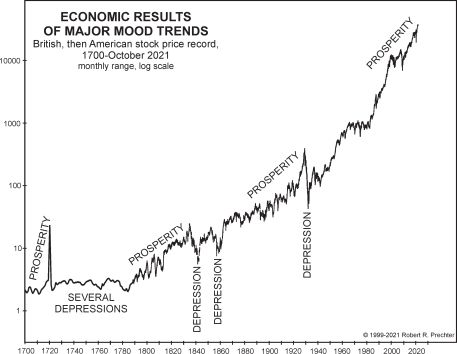
Part 2 - The changes in social mood give rise to history. They dictate economic events, political events. Social mood drives cultural trends and even philosophical trends. The 400 year history of stock prices show that the economy and politics follow the stock market. In other words, stocks are a leading indicator. This is because a change in social mood is first registered in stocks and the rest of the economy feels it later. But then can the stock market be predictable? This would require that the change in social mood is something that is predictable. Here comes the Elliott Wave Theory that identified fractal patterns in the form of waves in stock prices at all degrees, from 1 minute harts to 400 year stock market charts.

Part 3 - How perfectly does the market follow the wave principle? Consider the stock prices around 9/11. After a disastrous event like that our emotions could tell us the market would fall much lower. But soon after 9/11 the stock market started it’s rally and this had to happen because according to Elliott Wave Principle a 5 wave decline was already almost complete. Is it always possible to read the Elliott Waves correctly? Or do they have problems that reduce their usability? Yes, it is hard to know here you are in a bigger wave as you go. You may think you are at a top, yet the market may go higher. But waves combined with other market indicators can help you turn the odds in your favor in the markets.

Part 4 - What makes the stock market patterned? What makes the social mood patterned? What is a fractal pattern? Where else do we see similar patterns? Trees, ferns, blood vessels, lighting and more. The theory goes on to say that the society is part of the nature and the social mood is patterned just like the rest of the nature. This is what gives the patterned nature of the stock market prices.

Part 5 - A fractal is not the only patterned natural phenomenon we see in the nature and in stocks. There is another form that is commonly seen in the nature: A spiral. A logarithmic spiral depicts growth and expansion in the universe. How does a spiral connect to the stock market and the wave theory? This is the basis of the fibonacci numbers. The market wave lengths seem to be following the fibonacci sequence. Why is it that way? Perhaps simply because we are part of the nature and many other things follow the same patterns.

Part 6 - In a society whose social mood seems to be governed by the laws of nature, is there room for an omnipotent FED (Federeal Reserve) that can control the economy? Do the politicians really control the masses? Or are they at the mercy of the trends in social mood?

We hope you enjoyed watching this series as much as we did. Check back again for more videos and articles that challenges the traditional beliefs of out time on the stock market.

You can learn more about socionomics and effects of social mood at the Socionomics Institute.

Robert Prechter, Jr., president of Elliott Wave International, resurrected the Wave Principle from near obscurity in 1976 when he discovered the complete body of R.N. Elliott’s work in the New York Library. Robert Prechter, Jr. and A.J. Frost published Elliott Wave Principle in 1978. The book received enthusiastic reviews and became a Wall Street bestseller. In Elliott Wave Principle, Prechter and Frost’s forecast called for a roaring bull market in the 1980s, to be followed by a record bear market. Needless to say, knowledge of the Wave Principle among private and professional investors grew dramatically in the 1980s.

Deflationary Depression Coming?

Tuesday, November 8th, 2011

Social psychology precipitates economic depressions

Don’t blame Martin Van Buren for America’s first deflationary depression. Social mood rode higher in the saddle than did our 8th President, who only stood 5′ 6″.

Elected in 1836, by the time Van Buren assumed office in March 1837 a speculative bubble had burst and a banking crisis was at hand (sound familiar?) — the national mood had turned south and the “Panic of 1837″ followed. Van Buren was known as “The Little Magician,” but he could not pull an economic recovery out of the hat. He met defeat seeking a second term.

America’s first deflationary depression lasted until 1842. Van Buren blamed over-zealous business practices and a credit bubble (sound familiar 2x?). The panic precipitated bank failures; many speculators who bought land to capitalize on railroad expansion lost everything. The depression worsened as Van Buren continued Andrew Jackson’s economic policies. Businesses failed and unemployment was widespread. There were even “food riots” in several cities.

(Author’s note: Because of substantial revenue inflows into the Treasury during the boom of the early 1830s, the United States government became debt free in 1835. Ironically, this was the very year the depression began. Stock prices fell sharply despite the federal government paying off all of its debt. Conventional wisdom would have us believe reducing the national debt, or paying it off entirely, would lift stock prices. It didn’t happen in 1835, so there must be something else at work. That “something else” is social mood.)

The 1837-1842 deflationary depression comprised Supercycle Wave II, the end of which saw the beginning of the biggest economic expansion in history — Supercycle wave III! The 1929-1933 Great Depression still grabs more attention, but in fact the earlier Supercycle Wave II decline set the stage for the United States becoming the greatest economic and military power the world has ever known.

President Herbert Hoover held office during the 1929 Crash and onset of the Great Depression, a.k.a. Supercycle Wave IV. Yet no U.S. President has thus far been at the helm during a Grand Supercycle market decline. The last decline of that degree had its origin in the South Sea Bubble in 1720, when Great Britain’s King George I was on the throne. The rampant speculation of the time spread beyond the financial class, such that porters and ladies’ maids had enough money to buy their own carriages. Members of the clergy took part in the mania. Poof! Life savings were wiped out. England’s Postmaster General committed suicide. Hundreds of members of Parliament lost money. As for the directors of the South Sea Company itself, they were forced to give up their property and arrested to boot.

Martin Van Buren led the nation during our country’s first Supercycle depression — as President he was powerless to stop it. Who will occupy the Oval Office when the next Grand Supercycle depression develops? This we believe: That individual will be powerless to prevent it. He or she will only be a President.

What is more powerful than a President of the United States? The answer is “social mood.” How is this powerful force shaping the economy?

Discover the answer in the 90-page Free Report called the Deflation Survival Guide.


Now is the time to prepare for a deflationary depression. Start by reading the 90-page free eBook, Deflation Survival Guide, which includes Robert Prechter’s most important analysis and forecasts regarding deflation. This guide will help you survive a major deflationary trend, and even equip you to prosper.

Download your free eBook, the Deflation Survival Guide, now >>

Can The Federal Reserve Help Us Today

Friday, September 2nd, 2011

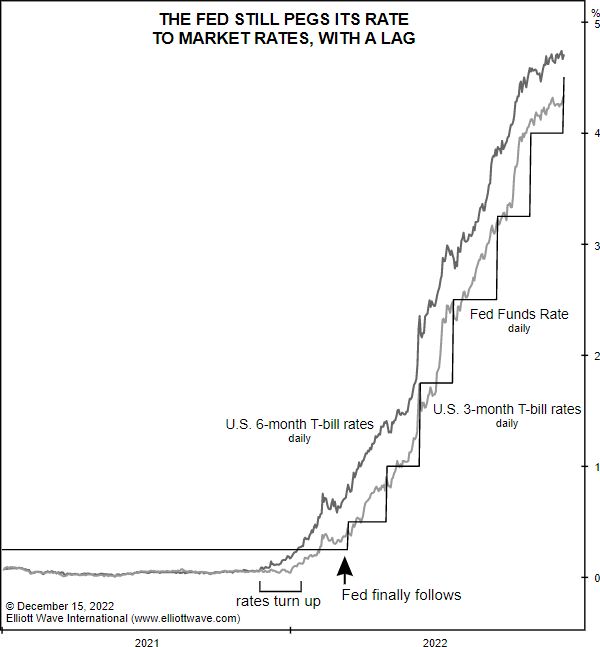
J.P. Morgan saved the banking system back in 1907. Then the Federal Reserve was created to protect the system in 1913. While the FED was at the helm, we had the Great Depression and the inflationary period of 70s. If we look at the stock market charts, it looks like market volatility has actually increased after the FED during the past century! Trying to help the economy, Bernanke said he is going to keep the rates low until 2013. So, he is going to make further borrowing easy. We are already awash in debt, so the plan is to increase borrowing with the help of low rates. Sounds like a plan?

“The Panic of 1907″ vs. the “Debt Crisis” of 2011

By Elliott Wave International

If “legendary Wall Street figure” ever described anyone, it was turn-of-the-last-century financier J.P. Morgan. You can throw in “bigger than life” to boot.

Morgan was used to getting his way. His steely eyes cast a “ferocious glare.” His bulbous nose added to his imposing presence.

Beyond appearance and persona, Morgan was a one-man central bank. Historians credit him with bringing calm, and loads of liquidity, to the “Panic of 1907.”

While he “stared down” that financial crisis, even J.P. Morgan would be no match for today’s national debt. In 1907, the Wall Street legend gathered New York City’s biggest bankers into his office and demanded that they had 10 minutes to collectively pledge $25 million to keep the NYSE open. Morgan got his way.

At the time that was a lot of money. But let’s see how far an equivalent sum (constant dollars) would go today.

I used several methods to calculate constant dollars from 1907, and the highest estimate (relative share of GDP) converts $25 million then to some $11 billion today.

Yet $11 billion doesn’t even make a dent in our $16 trillion national debt.

Interestingly, the 1907 Panic eventually led to the 1913 creation of the U.S. Federal Reserve. Then as now, the central bank’s function is “financial stability.”

Specifically, the Federal Reserve serves as a “lender of a last resort” — the role Morgan and his banker friends played in 1907.

Fast-forward ninety years: In 2002, Robert Prechter published Conquer the Crash (now in its second edition), and said this about the central bank:

“Congress authorized the Fed not only to create money for the government but also to ’smooth out’ the economy by manipulating credit (which also happens to be a re-election tool for incumbents). Politics being what they are, this manipulation has been almost exclusively in the direction of making credit easy to obtain.”

Sounds a lot like today, doesn’t it?

And just a few weeks ago, Fed Chairman Ben Bernanke said he wants to keep interest rates very low:

“Issuing a grim new assessment of the American economy, a divided Federal Reserve said it now expects to hold short-term interest rates near zero for at least two more years.”

Los Angeles Times, (8/10)

Since the start of the Great Recession, the Fed’s easy money policy has not restored health to the economy. Why should the same policy work in the next two years?

Notice how the above quote uses the phrase “a divided Federal Reserve.” With that in mind, here’s what Prechter published as recently as July 16:

“…when the trend in social mood turns down again, dissension will increase. The Fed is fracturing internally…”

Elliott Wave Theorist, July 2011

The U.S. Federal Reserve was created almost a century ago. Has it kept us financially stable? What does the future look like for America’s central bank?


Get your Free Report titled Understanding the Fed, and learn more about America’s “lender of last resort.”This complimentary report goes way beyond the history of the U.S. Federal Reserve, and shines a bright spotlight on the central bank’s machinations today. Most importantly, your free eBook helps prepare you and your family for the “economy of tomorrow.” We see big changes just ahead.Gain instant access to Understanding the Fed by simply joining Club EWI — a membership community of over 300,000 of the independently-minded. Membership is also free. Simply follow this link for your quick and easy sign-up>>

European Bank Stress Tests

Wednesday, July 20th, 2011

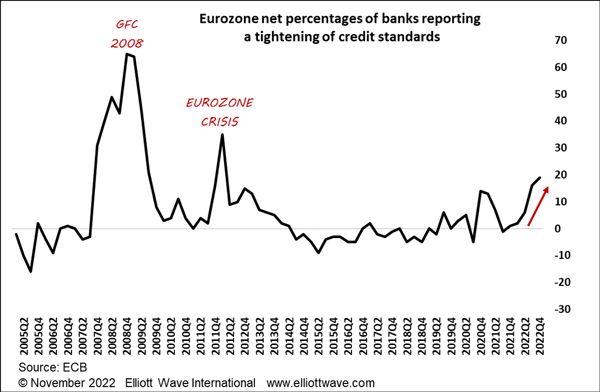
The European Banking Authority announced Friday that 8 banks had failed their stress tests and 16 more had narrowly passed. But the results drew much criticism from analysts, who said that the stress test is not strict enough.

Indeed, this is something that European Financial Forecast readers have known since the first stress test last summer.

For a unique perspective on Europe’s sovereign debt crisis, we invite you to read a free 6-page report by Elliott Wave International’s European Financial Forecast editor Brian Whitmer, “Credit Crisis in Europe.” Brian has been anticipating and tracking the credit contagion across Greece, Ireland, Spain, Portugal and other EU nations for months.

Below is a quick excerpt from this report, written just after the first stress test. For details on how to read it in full now, look below.
_________________________________________

Credit Crisis in Europe: How the Stability of an Entire Region is Teetering on the Edge of a Major Collapse

By EWI’s European Financial Forecast editor Brian Whitmer (excerpt)

Panic Now and Avoid the Rush — July 30, 2010
The market’s collective sigh of relief is also reflected in authorities’ stress testing of 91 European banks. In case you missed last Friday’s results, their message is clear: relax. The Committee of European Banking Supervisors (CEBS) gave passing grades to nearly every bank on its list. The group, for example, passed both Irish banks and all four UK banks that it evaluated. The CEBS gave clean bills of health to all four Portuguese banks, all five Italian banks, and five out of six Greek banks that it analyzed. Even with share prices that sit 29%-66% beneath their 2009 countertrend highs, the CEBS says that the Bank of Ireland, Piraeus Bank, Banco Popolare, and Banco Santander are all in good shape. In fact, just seven of the 91 banks failed to make the grade. Five were in Spain, one in Greece, and one, Germany’s Hypo Real Estate, is entirely owned by the German government anyway. Everyone else — 84 institutions in all — are supposed to be strong enough to withstand another economic shock.

Stress tests

It’s not so much the stellar results that expose the optimism of a Primary degree rally, but rather the Banking Committee’s stress tests themselves. They are notable primarily because they failed to test for any real stress in the first place. As the chart shows, the Committee’s “adverse scenario” regarding economic performance assumed a mere 3% deviation from the European Commission’s GDP forecast. Another test looked at banks’ resilience to a sovereign risk shock, yet the analysis merely used conditions similar to those of May 2010. In other words, just like the UK budget office, the CEBS is utilizing a woefully diluted version of the economic deterioration that is about to grip the continent.
______________________________

FREE REPORT: Discover what Europe’s debt crisis means for the future of the continent and your investments. Get your FREE 6-page report filled with unique analysis on Europe, the PIIGS and the sovereign debt crisis.EWI’s European Financial Forecast editor Brian Whitmer gives you the context for what’s happening in Europe and gets you up to speed on the reality of the situation. Download your free report now.

Money in the Bank

Saturday, June 11th, 2011

Elliott Wave International’s free report “Discover the Top 100 Safest U.S. Banks” explains the true risk that you may face when a bank fails.

Bank failures still dominate headlines as the number of failing banks continues at an alarming pace in 2011. The odds are that you’ve seen at least one bank failure in your community since the financial crisis hit in 2008. Some economists claim we’re in a recovery, yet hundreds of smaller financial institutions still suffer from the debt crisis that began a few years back.

Money in the Bank: Does It Still Mean “Safe and Sound?”

Consider this May 25 post from author Kalyan Nandy, on the popular Atlanta real estate site CityBiz: 

“Bank failures continue with no end in sight. Last Friday, U.S. regulators closed down three more banks, taking the total number to 43 so far in 2011…Looking back, there were 157 bank failures in 2010, 140 in 2009 and 25 in 2008.

“Issues like rock-bottom home prices, still-high loan defaults and deplorable unemployment levels are nagging troubles for such institutions…

“The number of banks on FDIC’s list of problem institutions shot up to 884 in the fourth quarter of 2010 from 860 in the previous quarter. This is the highest number since the savings and loan crisis in the early 1990s.”

The following excerpt from Elliott Wave International’s free report, Discover the Top 100 Safest U.S. Banks, explains the true risk that you may face when a bank fails.

Why do banks fail? For nearly 200 years, the courts have sanctioned an interpretation of the term “deposits” to mean not funds that you deliver for safekeeping but a loan to your bank. Your bank balance, then, is an IOU from the bank to you, even though there is no loan contract and no required interest payment. Thus, legally speaking, you have a claim on your money deposited in a bank, but practically speaking, you have a claim only on the loans that the bank makes with your money. If a large portion of those loans is tied up or becomes worthless, your money claim is compromised.

A bank failure simply means that the bank has reneged on its promise to pay you back. The bottom line is that your money is only as safe as the bank’s loans. In boom times, banks become imprudent and lend to almost anyone. In busts, they can’t get much of that money back due to widespread defaults. If the bank’s portfolio collapses in value, say, like those of the Savings & Loan institutions in the U.S. in the late 1980s and early 1990s, the bank is broke, and its depositors’ savings are gone…

The U.S. government’s Federal Deposit Insurance Corporation guarantee just makes things far worse, for two reasons. First, it removes a major motivation for banks to be conservative with your money. Depositors feel safe, so who cares what’s going on behind closed doors? Second, did you know that most of the FDIC’s money comes from other banks? This funding scheme makes prudent banks pay to save the imprudent ones, imparting weak banks’ frailty to the strong ones. When the FDIC rescues weak banks by charging healthier ones higher “premiums,” overall bank deposits are depleted, causing the net loan-to-deposit ratio to rise. This result, in turn, means that in times of bank stress, it will take a progressively smaller percentage of depositors to cause unmanageable bank runs.

If banks collapse in great enough quantity, the FDIC will be unable to rescue them all, and the more it charges surviving banks in “premiums,” the more banks it will endanger. Thus, this form of insurance compromises the entire system. Ultimately, the federal government guarantees the FDIC’s deposit insurance, which sounds like a sure thing. But if tax receipts fall, the government will be hard pressed to save a large number of banks with its own diminishing supply of capital. The FDIC calls its sticker “a symbol of confidence,” and that’s exactly what it is.

So what is the best course of action to safeguard your money?Read our free 10-page report, Discover the Top 100 Safest U.S. Banks, to learn:

• The 5 major conditions at many banks that pose a danger to your money.
• The top two safest banks in your state.
• Bob Prechter’s recommendations for finding a safe bank.
• And more!

Download your free report, Discover the Top 100 Safest U.S. Banks, now.

Quantitative Easing and Inflation

Friday, March 25th, 2011

FED is printing money. They call it “Quantitative Easing” aka QE1, QE2 and so on. Many economists think this expansion of FED balance sheet will create inflation in the near future. But they were saying that back in 2009 too. And two years later we still do not have the promised inflation. Base money supply expanded from 800 billion to almost 3 trillion. Yet we have outright deflation in some sectors such as housing. Yes Oil, Food and other commodities are up, but that seems to be due to demand/supply problems, not a shift in the purchasing power of the currency. US dollar is still at the same bottom levels that it was before the financial crash. So, why is the US dollar not in a free fall?

Club EWI’s Free Independent Investor eBook 2011 (excerpt)
Chapter 1: Quantitative Easing Has Not Brought Back the Old Inflationary Trend
(From Prechter’s January 2011 Elliott Wave Theorist)

While long terms rates are rising, Treasury bill rates are stuck near zero. How is that possible?

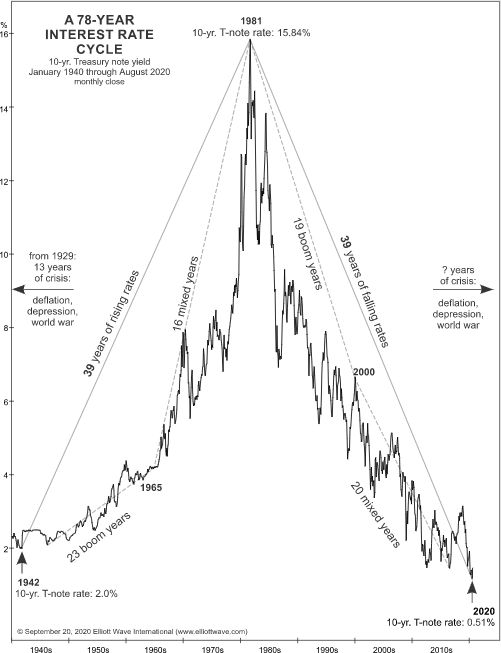
During hyperinflation, rates typically rise to double digits per month. Inflationists find it difficult to reconcile the Fed’s massive balance sheet growth over three years beginning in August 2008 with short term rates at zero and long term rates only in the 2-5% range.

Deflationists (that is us) understand why investors are willing to hold government paper at such low returns:  The total supply of debt is contracting. Most bonds won’t survive. The federal government’s bonds will survive the longest.

Figure 10 shows that the total supply of “money” plus debt (all of which is in fact debt) peaked in 2008. This decline in overall money and credit is the first on an annual basis since 1929-1933. It is a big deal.

 This chart explains why gold in 2010 was so much lonelier in making an all-time high than stocks, commodities and real estate were in 2006, when everything was making an all-time high simultaneously: The total money + credit supply is down and cannot support new highs in all markets at once.

The Fed’s QE programs are failing to re-ignite inflation. By mid-2011, the Fed will have monetized just over $2 trillion worth of debt since 2008 to bring the value of its total assets to about $3t. This does represent a huge amount of fiat money. But the overall debt load is $65 trillion. Thus, the Fed will have monetized only 5% of the total, meaning that 95% of the outstanding debt is still suffocating the economy like a giant pool of sludge. …The Fed’s degree of monetization in light of these debts is very small.


For more of Robert Prechter’s insights on the markets, including why QE2 was a major tactical error, why rising oil prices are not bearish for stock, and why earnings don’t drive stock prices, read the rest of this Download your FREE 51-page Independent Investor eBook NOW.

Can The FED Save The U.S. Economy?

Sunday, January 30th, 2011

Bernanke is at it again. His printing press is at work to create another 600 billion dollars. Bernanke declared the Economy needs it. The rationale is that if the government has more money coming from the FED, they can spend it and this Keynesian spending can jump start the economy. The assumption is that this will help us avoid a double dip recession. But is it really that easy? Afterall, if printing money was the answer, why do we not simply print it non-stop? Why did we not print it before the 2008 crash? Robert Prechter’s Conquer The Crash reveals whether the Fed really can save the US economy.

Since its creation in 1913, the primary intended role of the U.S. Federal Reserve Bank has been that of protector. In theory, the central bank was bestowed with the power to shape monetary policy in a way that would keep both booms and busts in check. The two main tools at its disposal - interest rates and money creation - would provide a “ceiling of normalcy” above expansions AND a “net of safety” below contractions.

To this day, the financial mainstream holds great faith in the Fed’s ability to fulfill its save-the-day duties - as these recent news items make plain:

  • “Why Raising Fed Funds Rate Is Positive For Equities.” (Seeking Alpha)
  • “Fed’s Moves Lift All Asset Classes.” (Associated Press)
  • “US Stocks Erasing Losses: The aggressive moves of the Fed have been an important driver for the stabilization of stock prices.” (Bloomberg)

But of all the variables the Fed creators took into account, there’s one glaring factor they neglected to consider: Namely, it cannot force consumers to spend, creditors to lend, or businesses to borrow. The events of 2007-2009 “credit crunch” and the subsequent “Great Recession” made that obvious. Remember how the government was upset at banks for sitting on the bailout funds instead of lending them out to consumers? And consumers weren’t exactly lining up on the street to get a loan, either.

The Fed’s inability to change social mood is the central theme in Chapter 13 of EWI President Bob Prechter’s NY Times business bestseller book Conquer the Crash. There, Prechter describes the Fed’s strategy of lowering the federal funds rate to stimulate spending to be as effective as “pushing on a string.”Writes Bob:

“The primary basis for today’s belief in perpetual prosperity and inflation with an occasional recession is what I call the ‘Potent Directors Fallacy.’ It is nearly impossible to find a treatise on macroeconomics today that does not assert or assume that the Federal Reserve Board has learned to control both our money and our economy. Many believe that it also possesses the immense power to manipulate the stock market. The very idea that it can do these things is false.”

2008 crash happened despite FED intervention to the economy. Since then nothing has been fixed. We are doing more of the same that brought us the crash. Will Keynesian spending stop another economic downturn? Have we really found the magic bullet to kill the beast? Or is the FED intervention to the free markets planting the seeds of a misaligned economy with misallocated resources that will eventually collapse?

So begins one of the most groundbreaking studies into the very real INABILITY of the Fed to defeat the great bears of economic declines, or to feed the great bulls of economic vigor.

The best part is, you can read Chapter 13 of Conquer the Crash in its entirety FREE via a Club EWI resource “You Can Survive And Prosper In A Deflationary Depression.” The free report also includes SEVEN other chapters of Conquer the Crash that shed equal light on some of the most misleading notions of mainstream economic wisdom.

Don’t stay in the dark. Read all 8 chapters today by joining the rapidly expanding free Club EWI community today. Here’s what you’ll learn:

  • Chapter 10: Money, Credit and the Federal Reserve Banking System
  • Chapter 13: Can the Fed Stop Deflation?
  • Chapter 23: What To Do With Your Pension Plan
  • Chapter 28: How to Identify a Safe Haven
  • Chapter 29: Calling in Loans and Paying off Debt
  • Chapter 30: What You Should Do If You Run a Business
  • Chapter 32: Should You Rely on Government to Protect You?
  • Chapter 33: A Short List of Imperative “Do’s” and Crucial “Don’ts”

Keep reading this free report now.

Understanding the Federal Reserve Bank

Thursday, November 25th, 2010

The world’s foremost Elliott wave expert Robert Prechter goes “behind the scenes” on the Federal Reserve Bank

November 25, 2010

By Elliott Wave International

The ongoing financial crisis has made the central bank’s decisions — interest rates, quantitative easing (QE2), monetary stimulus, etc. - a permanent fixture on six-o’clock news.

Yet many of us don’t truly understand the role of the Federal Reserve.

For answers, let’s turn to someone who has spent a considerable amount of time studying the Fed and its functions: EWI president Robert Prechter. Today we begin a 3-part series that we believe will help you understand the Fed as well as he does. (Excerpted from Prechter’s Conquer the Crash and the free Club EWI report, “Understanding the Federal Reserve System.”)

Money, Credit and the Federal Reserve Banking System
Conquer the Crash, Chapter 10
By Robert Prechter

An argument for deflation is not to be offered lightly because, given the nature of today’s money, certain aspects of money and credit creation cannot be forecast, only surmised. Before we can discuss these issues, we have to understand how money and credit come into being. This is a difficult chapter, but if you can assimilate what it says, you will have knowledge of the banking system that not one person in 10,000 has.

The Origin of Intangible Money

Originally, money was a tangible good freely chosen by society. For millennia, gold or silver provided this function, although sometimes other tangible goods (such as copper, brass and seashells) did. Originally, credit was the right to access that tangible money, whether by an ownership certificate or by borrowing.

Today, almost all money is intangible. It is not, nor does it even represent, a physical good. How it got that way is a long, complicated, disturbing story, which would take a full book to relate properly. It began about 300 years ago, when an English financier conceived the idea of a national central bank. Governments have often outlawed free-market determinations of what constitutes money and imposed their own versions upon society by law, but earlier schemes usually involved coinage. Under central banking, a government forces its citizens to accept its debt as the only form of legal tender. The Federal Reserve System assumed this monopoly role in the United States in 1913.

What Is a Dollar?

Originally, a dollar was defined as a certain amount of gold. Dollar bills and notes were promises to pay lawful money, which was gold. Anyone could present dollars to a bank and receive gold in exchange, and banks could get gold from the U.S. Treasury for dollar bills.

In 1933, President Roosevelt and Congress outlawed U.S. gold ownership and nullified and prohibited all domestic contracts denoted in gold, making Federal Reserve notes the legal tender of the land. In 1971, President Nixon halted gold payments from the U.S. Treasury to foreigners in exchange for dollars. Today, the Treasury will not give anyone anything tangible in exchange for a dollar. Even though Federal Reserve notes are defined as “obligations of the United States,” they are not obligations to do anything. Although a dollar is labeled a “note,” which means a debt contract, it is not a note for anything.

Congress claims that the dollar is “legally” 1/42.22 of an ounce of gold. Can you buy gold for $42.22 an ounce? No. This definition is bogus, and everyone knows it. If you bring a dollar to the U.S. Treasury, you will not collect any tangible good, much less 1/42.22 of an ounce of gold. You will be sent home.

Some authorities were quietly amazed that when the government progressively removed the tangible backing for the dollar, the currency continued to function. If you bring a dollar to the marketplace, you can still buy goods with it because the government says (by “fiat”) that it is money and because its long history of use has lulled people into accepting it as such. The volume of goods you can buy with it fluctuates according to the total volume of dollars — in both cash and credit — and their holders’ level of confidence that those values will remain intact.

Exactly what a dollar is and what backs it are difficult questions to answer because no official entity will provide a satisfying answer. It has no simultaneous actuality and definition. It may be defined as 1/42.22 of an ounce of gold, but it is not actually that. Whatever it actually is (if anything) may not be definable. To the extent that its physical backing, if any, may be officially definable in actuality, no one is talking. … 

Do you want to really understand the Fed? Then keep reading this free eBook, “Understanding the Federal Reserve”, as soon as you become a free member of Club EWI.

Money, Credit and the Federal Reserve Banking System
Conquer the Crash, Chapter 10
By Robert Prechter

… Let’s attempt to define what gives the dollar objective value. As we will see in the next section, the dollar is “backed” primarily by government bonds, which are promises to pay dollars. So today, the dollar is a promise backed by a promise to pay an identical promise. What is the nature of each promise? If the Treasury will not give you anything tangible for your dollar, then the dollar is a promise to pay nothing. The Treasury should have no trouble keeping this promise.

In Chapter 9 [of Conquer the Crash], I called the dollar “money.” By the definition given there, it is. I used that definition and explanation because it makes the whole picture comprehensible. But the truth is that since the dollar is backed by debt, it is actually a credit, not money. It is a credit against what the government owes, denoted in dollars and backed by nothing. So although we may use the term “money” in referring to dollars, there is no longer any real money in the U.S. financial system; there is nothing but credit and debt.

As you can see, defining the dollar, and therefore the terms money, credit, inflation and deflation, today is a challenge, to say the least. Despite that challenge, we can still use these terms because people’s minds have conferred meaning and value upon these ethereal concepts.

Understanding this fact, we will now proceed with a discussion of how money and credit expand in today’s financial system.

How the Federal Reserve System Manufactures Money

Over the years, the Federal Reserve Bank has transferred purchasing power from all other dollar holders primarily to the U.S. Treasury by a complex series of machinations. The U.S. Treasury borrows money by selling bonds in the open market. The Fed is said to “buy” the Treasury’s bonds from banks and other financial institutions, but in actuality, it is allowed by law simply to fabricate a new checking account for the seller in exchange for the bonds. It holds the Treasury’s bonds as assets against — as “backing” for — that new money. Now the seller is whole (he was just a middleman), the Fed has the bonds, and the Treasury has the new money.

This transactional train is a long route to a simple alchemy (called “monetizing” the debt) in which the Fed turns government bonds into money. The net result is as if the government had simply fabricated its own checking account, although it pays the Fed a portion of the bonds’ interest for providing the service surreptitiously. To date (1st edition of Prechter’s Conquer the Crash was published in 2002 — Ed.), the Fed has monetized about $600 billion worth of Treasury obligations. This process expands the supply of money.

In 1980, Congress gave the Fed the legal authority to monetize any agency’s debt. In other words, it can exchange the bonds of a government, bank or other institution for a checking account denominated in dollars. This mechanism gives the President, through the Treasury, a mechanism for “bailing out” debt-troubled governments, banks or other institutions that can no longer get financing anywhere else. Such decisions are made for political reasons, and the Fed can go along or refuse, at least as the relationship currently stands. Today, the Fed has about $36 billion worth of foreign debt on its books. The power to grant or refuse such largesse is unprecedented.

Each new Fed account denominated in dollars is new money, but contrary to common inference, it is not new value. The new account has value, but that value comes from a reduction in the value of all other outstanding accounts denominated in dollars. That reduction takes place as the favored institution spends the newly credited dollars, driving up the dollar-denominated demand for goods and thus their prices. All other dollar holders still hold the same number of dollars, but now there are more dollars in circulation, and each one purchases less in the way of goods and services. The old dollars lose value to the extent that the new account gains value.

The net result is a transfer of value to the receiver’s account from those of all other dollar holders. This fact is not readily obvious because the unit of account throughout the financial system does not change even though its value changes.

It is important to understand exactly what the Fed has the power to do in this context: It has legal permission to transfer wealth from dollar savers to certain debtors without the permission of the savers. The effect on the money supply is exactly the same as if the money had been counterfeited and slipped into circulation.

In the old days, governments would inflate the money supply by diluting their coins with base metal or printing notes directly. Now the same old game is much less obvious. On the other hand, there is also far more to it. This section has described the Fed’s secondary role. The Fed’s main occupation is not creating money but facilitating credit. This crucial difference will eventually bring us to why deflation is possible.


Read more now in the free Club EWI report “Understanding the Federal Reserve Bank.”

How the Federal Reserve Has Encouraged the Growth of Credit

Congress authorized the Fed not only to create money for the government but also to “smooth out” the economy by manipulating credit (which also happens to be a re-election tool for incumbents). Politics being what they are, this manipulation has been almost exclusively in the direction of making credit easy to obtain. The Fed used to make more credit available to the banking system by monetizing federal debt, that is, by creating money. Under the structure of our “fractional reserve” system, banks were authorized to employ that new money as “reserves” against which they could make new loans. Thus, new money meant new credit.

It meant a lot of new credit because banks were allowed by regulation to lend out 90 percent of their deposits, which meant that banks had to keep 10 percent of deposits on hand (“in reserve”) to cover withdrawals. When the Fed increased a bank’s reserves, that bank could lend 90 percent of those new dollars. Those dollars, in turn, would make their way to other banks as new deposits. Those other banks could lend 90 percent of those deposits, and so on. The expansion of reserves and deposits throughout the banking system this way is called the “multiplier effect.” This process expanded the supply of credit well beyond the supply of money.

Because of competition from money market funds, banks began using fancy financial manipulation to get around reserve requirements. In the early 1990s, the Federal Reserve Board under Chairman Alan Greenspan took a controversial step and removed banks’ reserve requirements almost entirely. To do so, it first lowered to zero the reserve requirement on all accounts other than checking accounts. Then it let banks pretend that they have almost no checking account balances by allowing them to “sweep” those deposits into various savings accounts and money market funds at the end of each business day. Magically, when monitors check the banks’ balances at night, they find the value of checking accounts artificially understated by hundreds of billions of dollars. The net result is that banks today conveniently meet their nominally required reserves (currently about $45b.) with the cash in their vaults that they need to hold for everyday transactions anyway. [1st edition of Prechter's Conquer the Crash was published in 2002 -- Ed.]

By this change in regulation, the Fed essentially removed itself from the businesses of requiring banks to hold reserves and of manipulating the level of those reserves. This move took place during a recession and while S&P earnings per share were undergoing their biggest drop since the 1940s. The temporary cure for that economic contraction was the ultimate in “easy money.”

We still have a fractional reserve system on the books, but we do not have one in actuality. Now banks can lend out virtually all of their deposits. In fact, they can lend out more than all of their deposits, because banks’ parent companies can issue stock, bonds, commercial paper or any financial instrument and lend the proceeds to their subsidiary banks, upon which assets the banks can make new loans. In other words, to a limited degree, banks can arrange to create their own new money for lending purposes.

Today, U.S. banks have extended 25 percent more total credit than they have in total deposits ($5.4 trillion vs. $4.3 trillion). Since all banks do not engage in this practice, others must be quite aggressive at it. For more on this theme, see Chapter 19 [of Conquer the Crash].

Recall that when banks lend money, it gets deposited in other banks, which can lend it out again. Without a reserve requirement, the multiplier effect is no longer restricted to ten times deposits; it is virtually unlimited. Every new dollar deposited can be lent over and over throughout the system: A deposit becomes a loan becomes a deposit becomes a loan, and so on.

As you can see, the fiat money system has encouraged inflation via both money creation and the expansion of credit. This dual growth has been the monetary engine of the historic uptrend of stock prices in wave (V) from 1932. The stupendous growth in bank credit since 1975 (see graphs in Chapter 11) has provided the monetary fuel for its final advance, wave V. The effective elimination of reserve requirements a decade ago extended that trend to one of historic proportion.

The Net Effect of Monetization

Although the Fed has almost wholly withdrawn from the role of holding book-entry reserves for banks, it has not retired its holdings of Treasury bonds. Because the Fed is legally bound to back its notes (greenback currency) with government securities, today almost all of the Fed’s Treasury bond assets are held as reserves against a nearly equal dollar value of Federal Reserve notes in circulation around the world. Thus, the net result of the Fed’s 89 years of money inflating is that the Fed has turned $600 billion worth of U.S. Treasury and foreign obligations into Federal Reserve notes.

Today the Fed’s production of currency is passive, in response to orders from domestic and foreign banks, which in turn respond to demand from the public. Under current policy, banks must pay for that currency with any remaining reserve balances. If they don’t have any, they borrow to cover the cost and pay back that loan as they collect interest on their own loans. Thus, as things stand, the Fed no longer considers itself in the business of “printing money” for the government. Rather, it facilitates the expansion of credit to satisfy the lending policies of government and banks.

If banks and the Treasury were to become strapped for cash in a monetary crisis, policies could change. The unencumbered production of banknotes could become deliberate Fed or government policy, as we have seen happen in other countries throughout history. At this point, there is no indication that the Fed has entertained any such policy. Nevertheless, Chapters 13 and 22 address this possibility.

Do you want to really understand the Fed? Then keep reading this free eBook, “Understanding the Federal Reserve”, as soon as you become a free member of Club EWI.

The Deflationary Spiral

Thursday, September 23rd, 2010

FED is getting ready to print more money to stimulate the economy. Total bank credit has stopped expanding. Total debt, which is principal + interest, is more than the money supply, which is principal only. As the shortage of US dollars forces foreclosures and bankrutpcies, FED and the government is cherry picking favored ones to be bailed out. So the question is: Can the FED stop deflation? What if FED were to print $5000 per borrower, and hand it out? Would you spend it, or would you pay outstanding debt with it? As people choose to deleverage by paying down debt, the velocity of money is declining and consumer credit is shrinking. And there is more. Let us read what else is deflationary.

September 23, 2010

By Elliott Wave International

As the biggest credit bubble in history continues to shrink, consumer prices have stayed flat over the past several months, meaning there is no sign of inflation to come, despite growing commitments from the U.S. government.

So what’s keeping inflation at bay, given all the stimulus money promised? The answer is: Deflation - an overwhelming urge for consumers to liquidate their assets for cash. And this new economic phase is finally becoming too obvious to ignore, as explained in recent commentary from the world’s largest technical analysis firm.

“The economy is moving into a critical new phase, an outright deflation in which ‘prices fall because people expect falling prices.’ Obviously, this implies an element of recognition, as efforts to protect against indebtedness and falling prices contribute to further declines. We can tell deflation is entering a new stage because of the language and ideas that financial observers now use to describe it.”
– The Elliott Wave Financial Forecast (September 2010)

Get an independent look at the future of the U.S. economy by reading Robert Prechter’s FREE Deflation Survival Guide. Newly updated for 2010, Prechter’s 90-page ebook on deflation reveals the biggest threat to your money right now. You’ll learn not only how to prepare for deflation and adapt during it; you’ll also learn how to survive it and, most important, prosper during it, so you’ll be ready for the buying opportunity of a lifetime at its end. Click Here to Download Your 90-Page Deflation eBook for FREE.

Here are a few recent comments about the new economic reality:

  • “[New Jersey Governor] Christie spelled out the details of his proposal Tuesday. They include: repealing an increase in benefits approved years ago; eliminating automatic cost-of-living adjustments; raising the retirement age to 65 from 60 in many cases; reducing pension payouts for many future retirees; and requiring some employees to contribute more to their pensions.” — Associated Press (Sept. 15)
  • “U.S. Home Prices Face Three-Year Drop as Inventory Surge Looms” — Bloomberg (Sept. 15)
  • “Atlanta Awash in Empty Offices Struggles to Recover From Building Binge” — Bloomberg (Sept. 14)
  • “The world economy faces a long, hard slog toward recovery and could slide into deflation and financial instability if leaders fail to deliver on promises of reform.” — Reuters (Sept. 10)
  • “Deflation seems to have the upper hand lately in the debate among investors about inflation versus deflation.” — Marketwatch (Sept. 8 )
  • “With the release of the August sales figures, one thing is clear for car shoppers — it’s a buyer’s market.” — Edmunds (Sept. 2)
  • “20 Funds to Guard Against Deflation” — Smartmoney (Aug. 29)
  • “Dividend-Yield Signal Screams Deflation” — Forbes (Aug. 25)

The word “deflation” also started appearing more in the financial media around 2002, but Robert Prechter, president of technical analysis firm Elliott Wave International and author of the 2002 New York Times best-seller Conquer the Crash, added in the updated 2009 edition of his book that the deflation references back then were in an entirely different context:

“The rarely used word deflation has become fashionable in financial discussion. … It is fashionable, however, not to predict its occurrence but primarily to dismiss the idea that it has any serious likelihood of occurring. The president of the Federal Reserve Bank of Dallas said in May [2004] that there is ‘maybe one chance out of four’ that deflation will occur.”
– Conquer the Crash, 2nd edition (2009)

And Prechter says the opinion from the Federal Reserve Bank of Dallas was not an isolated outlook at the time. Here’s another quote from around the same time:

“Not one economist [of 67 surveyed] said it was ‘very likely’ the economy would slip into deflation, and only 6% said it was ’somewhat likely.’ About 95% said deflation was ‘not very likely’ to happen.” — Barron’s (2003)

In hindsight, we know that economists — in the aggregate — were dead wrong about their deflation predictions.

As we saw above, references to “deflation” are increasing now — because it’s obvious.

So if economists were unable — or worse, unwilling — to warn you in advance about the threat of deflation a few years ago, what are they not warning you about now?

Get an independent look at the future of the U.S. economy by reading Robert Prechter’s FREE Deflation Survival Guide now. Newly updated for 2010, Prechter’s 90-page ebook on deflation reveals the biggest threat to your money right now. You’ll learn not only how to prepare for deflation and adapt during it; you’ll also learn how to survive it and — most important — prosper during it, so you’ll be ready for the buying opportunity of a lifetime at its end. Click here to download your free 90-Page Deflation eBook now.

Day of Reckoning: Deflationary Depression is Near

Friday, July 23rd, 2010

The total outstanding debt in the world is approaching record levels. Most are preparing for inflation thinking that central banks will be printing money to pay the debt. What if someone told you inflation is not the immediate danger, but deflation is? Why? Because our money supply is not printed money. It is debt. When debt deflates, it is money supply that deflates. Most of the world’s debt is denominated in US dollars. Creditors are asking for US dollars to be paid back. Not gold, not stocks, not houses. This creates demand for US dollars. This is why when there is a debt crisis, US dollar goes up. US dollar has already lost it’s value due to excessive borrowing for decades. Now it is time to move up. Here is an article about the excessive debt burden of many developed countries.

By Elliott Wave International

The biggest balloon in the world is deflating.

This balloon had been inflated with a quadrillion (1015) dollars, which is to say: This balloon was filled not with air but with debt from around the globe.

What will happen as this global debt winds down? In two words: Deflationary Depression — the likes of which could be unprecedented in history. Want to Learn

How to Prosper in a Deflationary Depression?
You should not miss Robert Prechter’s deflation argument.
Download 60 Page Guide to Understanding Deflation here.

A thousand trillion in debt can’t be wished away or swept under the rug. No one can “forgive” the debt. The consequences of unwinding this debt could be as massive as the dollar figure itself.

We’ve heard plenty about the debt problems of Greece, Spain, Portugal and Italy.

But how about the world’s second largest economy? Consider this fact reported in the Japan Times (July 8):

“Japan’s government debts are the highest the world has ever seen, at 219 percent of gross domestic product, according to the International Monetary Fund.”

Then there’s the world’s sixth largest national economy. In January 2009,  Robert Prechter wrote this in the Elliott Wave Theorist:

“British banks have amassed $4.4 trillion worth of foreign liabilities, twice Britain’s annual GDP. … England, moreover, ‘has not defaulted since the Middle Ages.’ The possibility that it may do so again is yet another indication that the bear market is of … (larger) degree, exactly as Elliott wave analysts have predicted all along.”

Remember, Japan and Great Britain are major world economies. Imagine what the debt totals would look like in a line-item analysis of other nations, regions, states, provinces and municipalities around the world, including the U.S.

De-leveraging will likely lead to a deflationary crash — a “day of reckoning.”

How can you prepare for a deflationary crash?

To start with, keep your money safe. As Bob Prechter mentions in his June 2010 Elliott Wave Theorist:

“Investors should be primarily in greenback cash and Treasury bills.”

He also describes holdings which should be strictly avoided.

Learn How to Prosper in a Deflationary Depression?
Download Guide to Understanding Deflation here.