The widespread idea is that events around the world direct the financial markets. We are told to believe that the market reacts to the news and people’s mood changes accordingly. When the news are good, people feel good and they buy stocks they say. When the news are bad, people sell stocks according to the orthodox view. But is that really so? What if it was the other way around? What if the mood changed first and it’s economic, political and social effects became apparent later? Could it be possible? If not, why can’t the news editors trade the markets get rich? Would you get rich if you knew the news ahead of everyone else? If you are Rothschild, maybe. But for the rest of us, it is not so clear cut.
History’s Hidden Engine
Part 1 - Presumed cause and effect relationship goes like this: War, prosperity, civil protest dictates society’s social mood. A strong economy, good leaders, rising stock market creates positive social mood. Adversely, inept leaders, bad economy, unemployment, declining markets create negative social mood. We will now start to look into this entrenched belief. What if the change in social mood was the cause of the rest? The part 1 of this series of videos talks about the correlation between stock prices and the rest of the social events such as pop culture, clothing, music, movies. Certain social trends become apparent at stock market tops and bottoms.
Part 2 - The changes in social mood give rise to history. They dictate economic events, political events. Social mood drives cultural trends and even philosophical trends. The 400 year history of stock prices show that the economy and politics follow the stock market. In other words, stocks are a leading indicator. This is because a change in social mood is first registered in stocks and the rest of the economy feels it later. But then can the stock market be predictable? This would require that the change in social mood is something that is predictable. Here comes the Elliott Wave Theory that identified fractal patterns in the form of waves in stock prices at all degrees, from 1 minute harts to 400 year stock market charts.
Part 3 - How perfectly does the market follow the wave principle? Consider the stock prices around 9/11. After a disastrous event like that our emotions could tell us the market would fall much lower. But soon after 9/11 the stock market started it’s rally and this had to happen because according to Elliott Wave Principle a 5 wave decline was already almost complete. Is it always possible to read the Elliott Waves correctly? Or do they have problems that reduce their usability? Yes, it is hard to know here you are in a bigger wave as you go. You may think you are at a top, yet the market may go higher. But waves combined with other market indicators can help you turn the odds in your favor in the markets.
Part 4 - What makes the stock market patterned? What makes the social mood patterned? What is a fractal pattern? Where else do we see similar patterns? Trees, ferns, blood vessels, lighting and more. The theory goes on to say that the society is part of the nature and the social mood is patterned just like the rest of the nature. This is what gives the patterned nature of the stock market prices.
Part 5 - A fractal is not the only patterned natural phenomenon we see in the nature and in stocks. There is another form that is commonly seen in the nature: A spiral. A logarithmic spiral depicts growth and expansion in the universe. How does a spiral connect to the stock market and the wave theory? This is the basis of the fibonacci numbers. The market wave lengths seem to be following the fibonacci sequence. Why is it that way? Perhaps simply because we are part of the nature and many other things follow the same patterns.
Part 6 - In a society whose social mood seems to be governed by the laws of nature, is there room for an omnipotent FED (Federeal Reserve) that can control the economy? Do the politicians really control the masses? Or are they at the mercy of the trends in social mood?
We hope you enjoyed watching this series as much as we did. Check back again for more videos and articles that challenges the traditional beliefs of out time on the stock market.
You can learn more about socionomics and effects of social mood at the Socionomics Institute.
Robert Prechter, Jr., president of Elliott Wave International, resurrected the Wave Principle from near obscurity in 1976 when he discovered the complete body of R.N. Elliott’s work in the New York Library. Robert Prechter, Jr. and A.J. Frost published Elliott Wave Principle in 1978. The book received enthusiastic reviews and became a Wall Street bestseller. In Elliott Wave Principle, Prechter and Frost’s forecast called for a roaring bull market in the 1980s, to be followed by a record bear market. Needless to say, knowledge of the Wave Principle among private and professional investors grew dramatically in the 1980s.
You get a review of ALL of the charts and ALL of the indicators that EWI has been watching over the past year or so — to provide you the full impact of what they are seeing. The entire picture will show you a rather radical conclusion about the future of stock prices.
Don’t delay! “Most Important Report for 2012″ is only available for a few more days.
Some cite the good earnings that we have had. According to Robert Prechter, good earnings, or record earnings actually appear at the stock market top or right after the top:
In this CNBC video Prechter explains his bearish view for the next few years. According to his analysis 2012 is likely to witness a bear market in stocks, commodities and there will be no place to hide, no place to diversify. Debt is the problem and there is too much of it now. This practically impossible to pay debt provides the deflationary pressures in the economy.
Stocks topped in April 2011, Gold topped in 2011, many foreign markets topped even earlier. 2012 is likely to be the year of US dollar. Ironically, the sickest currency US dollar is in short supply. Entire world went on a borrowing spree for decades and they promised to pay back with interest in the future. The future has arrived.
But what will the stocks do? Can the stock market survive 2012? Or is it going to be a year that goes into history as one of the great crashes of all time?
Market had a sharp decline 2 months ago. We are well below 200 day average, and we have bounced off of 38.6% fibonacci retracement level a few times. Price support level has been holding well. Now the sentiment in the mainstream media is that this is a healthy pullback, a buying opportunity in the stock market. One needs to consider the big picture and ask the question: Have we seen the stock market bottom yet?
Here’s why you SHOULDN’T get too comfortable
Bear markets are cunning beasts.
Don’t get me wrong — we are not in the bear market territory yet. At least, not officially. But if this is the beginning of a bear market, then what we are seeing is a bear market rally.
An “official” bear market begins when the stocks indexes decline 20%. The DJIA’s decline from the May 2, 2011 high to the September 21 low is about 17%. Close, but no cigar.
Add to that the strong rallies we’ve seen over the past few weeks (Sept. 12-20: +685 points in the Dow, for example) — and lots of people conclude that despite the volatility, things aren’t so bad.
But let’s get some perspective. The stock market has been around a while. Only when you look at its history do you realize just how cunning — and fast, and strong — bear markets can be. Past recessions and depressions have displayed examples of extraordinary bear market rallies before the prices hit the ultimate stock market bottom.
Here’s a chart we’ve shown readers before. It’s worth printing out and keeping on the wall above the desk where you open your brokerage statements.
This is the DJIA between 1930 and 1932, one of the worst bear markets in history. Robert Prechter, EWI’s president, took the time to measure the percentage gain of each bear market rally during the 2-year period — you can see them in this chart.
When you routinely see double-digit rallies (11 percent, 18 percent, even 39%) over the course of two or three years, it’s easy to be lulled into thinking that maybe things aren’t so bad. Here we are counting 7 bear market rallies some of which would make you feel like a bull market with is time length and price gain.
The reality, of course, is that the bear market’s chokehold grows tighter around your neck with every drop-rally sequence. (Think back to the 2007-2009 collapse, and you’ll remember the same behavior.)
Which brings us to here and now. Rallies and declines of 300-400+ points have been so common since August that we’re kinda getting used to them.
The question is: Are we in a bear market, or is it that “maybe things aren’t so bad”?
You need some perspective to answer that question. The research we do here at EWI can help.
Free Report: Stocks — Buying Opportunity or Another “Free Fall” Ahead?Find out what these market moves mean to your investments with current analysis from Elliott Wave International. Bob Prechter has just released a FREE report — with urgent analysis from his August and September 2011 Elliott Wave Theorist market letters, including another video excerpt from the special video issue of the August Theorist.
Stocks — Buying Opportunity or Another “Free Fall” Ahead? will help you put these uncertain markets into perspective so that you’ll be better positioned to both protect your investments when needed and prosper when opportunities arise.
(Video) Bob Prechter Explains ‘Triple Top’ Forming in U.S. Stock Market
This excerpt from the special video issue of the August Elliott Wave
Theorist brings you Bob Prechter’s analysis of the triple top
that has been forming in the U.S. stock market over the past 12 years.
Watch as Bob himself explains what this pattern means for you and the markets.
You can get even more analysis – including an 84-year
study of stock values – that will help you gain perspective
about the recent market moves with Elliott Wave International’s FREE
report, “Reality Check: Studying the Past to Bring
Clarity to the Future.”
You’ll get a glimpse into the in-depth analysis Robert Prechter presents
each month in his Elliott Wave Theorist with 3 excerpts from
his most recent issues.
Don’t let extreme market volatility leave you confused and scared. Prepare
yourself for today’s critical market juncture with your FREE report from
Robert Prechter.
We are witnessing one of those times that future generations will read in history books just like we read about the great stock market crash of the Great Depression. It is rare that decades and centuries of economic cycles top all together at the same time to form the perfect storm. The World’s debt problems, stock market bubble, housing bubble, credit bubble, are all coming together to threaten the capitalist economies as we know them. Past decade has witnessed multiple degrees of Elliott Waves end their final 5th of 5th waves. This is a rare top that happens once in 400 years. Kondratieff cycle is going through it’s Kondratieff Winter phase that is about to strengthen it’s deflationary grip on the economy. And if you are lucky enough to be sitting with a pile of cash, then you will first witness one of the greatest short opportunities in the stock market, followed by the greatest buying opportunity of a life time. Good luck.
Bob Prechter Discusses Market Forecasts on CNBC Closing Bell
“The problem is deeper than just a minor recovery or a minor recession.”
Robert Prechter joins CNBC hosts Bill Griffeth and Maria Bartiromo on Closing Bell to talk about the still-unfolding forecasts presented in his New York Times bestsellerConquer the Crash.
We invite you to watch the interview below. Then download Robert Prechter’s free stock market report that uses an 84-year study of stock market values to help you prepare for and understand today’s critical market juncture.
Download Robert Prechter’s Free Report To Discover How You Can Prepare For Today’s Critical Market Juncture
While we’re sure you’re reading countless articles and analysis about the market’s recent volatility, if you’re not reading what EWI’s subscribers read, you’re missing the valuable, prescient perspective contained in each issue of Prechter’s market letter, TheElliott Wave Theorist.
Access Robert Prechter’s free report and read in-depth analysis, including an 84-year study of stock values, that will help you prepare for and understand today’s critical market juncture.
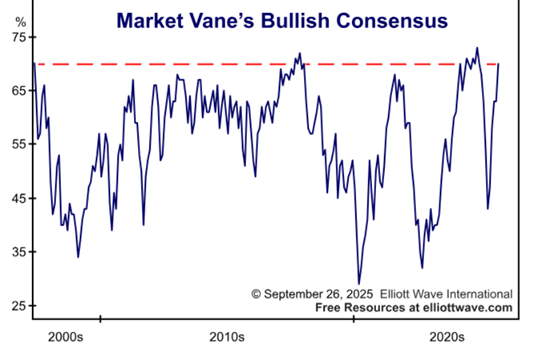
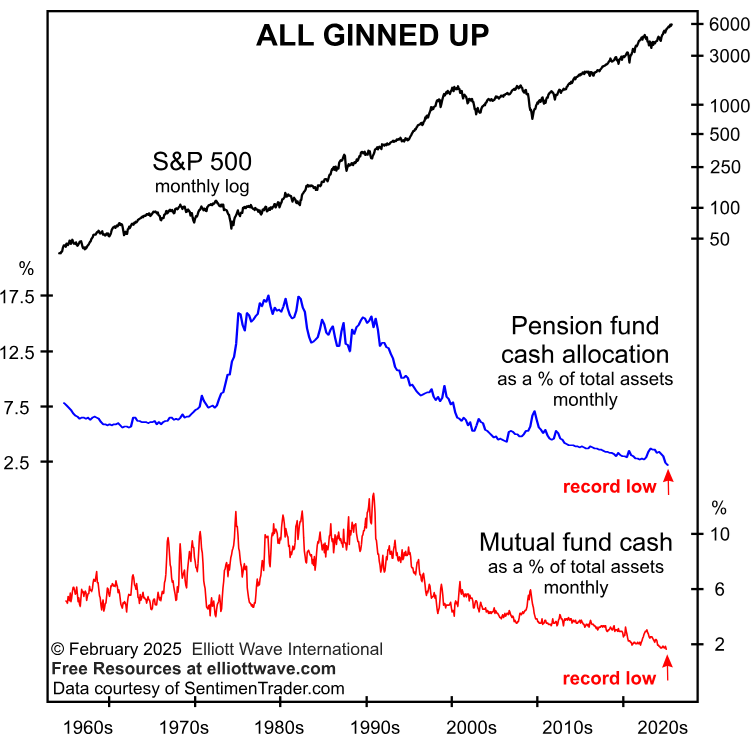
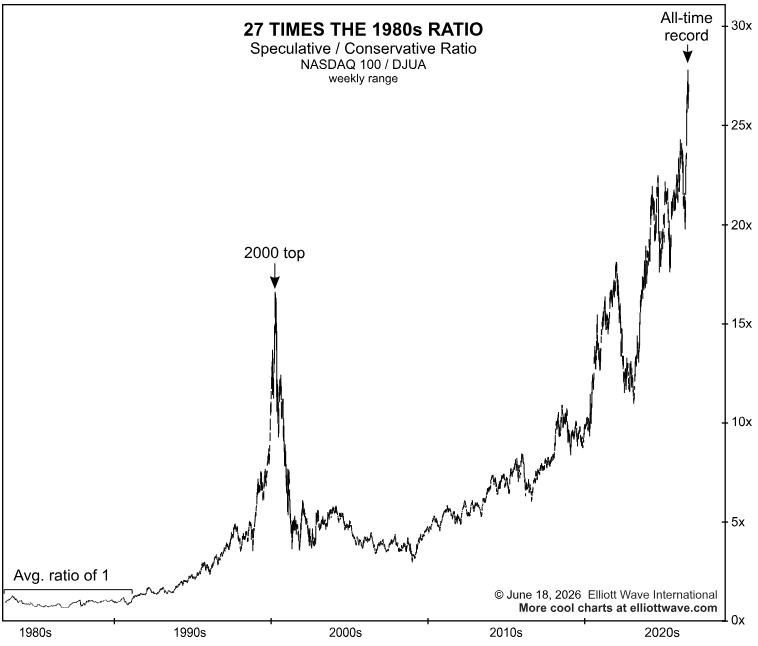
The market is falling and has just broken the neck down in the widely watches head and shoulders pattern. Those who are trading stocks, the savvy ones who prefer stock market timing instead of buy and hold are shorting the stocks. Most people pay attention to the news and events and they try to buy sell accordingly. But news and events do not move the stocks. News are about the past and they hardly predict the future. It is like looking at the rear view mirror and trying to drive. There are various other technical indicators some of which do have predictive value. One of these is the traders sentiment. How many people are bullish? And how many people are bearish. The reasoning is simple: If everyone is already bullish, then every who can buy has already bought. We are out of buyers, therefore only 1 thing can happen: They can change their mind and start becoming bearish again. And when they do so, they sell stocks, driving the prices down. Going to the recent stock market top, we had these indicators ring the bells.
In this video excerpt, Elliott WaveFinancial Forecast Editor
Steve Hochberg explains one of the most important things to keep in mind when
assessing a market, “Extreme opinions, shared widely, constitute the single
most reliable indicator of an impending change of direction for a market.” Enjoy
your video excerpt.
To find out more about the Wave Principle, be sure to watch the Club EWI video
series: Learn the Why, What and How of Elliott Wave Analysis. This 3-video series
is a great way to get started with the Wave Principle. You can watch these
videos free with a Club EWI Membership.
Technical analysis helps in recognizing the markets direction and possible turning points. There is no one-size fits all silver bullet solution to get you ahead of the crowd all the time. By definition, only the few will make money in the stock market. And we can use some tools to enhance the odds in our favor. Here is one such tool to help us in our stock market trades:
A Four-Chart Lesson in Spotting Trade Setups
You can find low-risk, high-probability trading opportunities by trading with the trend. The trick is to find the end of market corrections, so you can position yourself for the next move in the direction of the trend.
This excerpt from Jeffrey Kennedy’s free 47-page eBook How to Spot Trading Opportunities explains where to find bullish and bearish trade setups in your charts and how to zero-in on these opportunities. If this lesson interests you, the full 47-page eBook is free through July 6.
On the left-hand side of the illustration below, there are two bullish trade setups. As traders, we want to wait for the wave (2) correction to be complete so we can catch the move up in wave (3) – this is the trade. What we are trying to do in this bullish trade setup is anticipate the potential for profits on the buy-side as prices move up in wave (3). Another bullish trade setup is at the end of wave (4).
As traders, we are looking to buy the pullback and position ourselves within the direction of the larger up-trend. Remember, three-wave moves are corrections, which means that they are countertrend structures. On the other hand, five-wave moves define the larger trend. As traders, we want to determine what the trend is and trade in the direction of the trend. Our buying opportunity to rejoin the trend is whenever the trend pauses and forms a correction.
Now, let’s look at the right-hand side of the illustration where we see two bearish setups. When a five-wave move is complete, it is retraced in three waves as a correction. The end of the five-wave move presents the first trading opportunity that we can take advantage of the short side (or the sell side) as the wave (A) down begins.
Notice the second bearish trade setup gives us another shorting opportunity as wave (B) tops.
So, within the classic wave pattern of five waves up and three waves down, we have four high-probability trading opportunities in which we are either positioning ourselves in the direction of the trend or identifying termination points of a trend. I want to share with you some tricks I have picked up over the years about how to analyze corrective waves and their termination points. The single most important thing I’ve learned from analyzing corrections is that corrective or countertrend price action is usually contained by parallel lines.
As shown above, draw the parallel lines by beginning at the origin of wave A and going to the extreme of wave B. You draw a parallel of that line off the extreme of wave A. So basically you have a small, slightly angled downward price channel. This will show you the containment region for wave C. It also shows you an area toward the bottom of the lower trend line where you can expect a reversal in price.
Here is another example. Again, you draw the parallel lines off the origin of wave A, the extreme of wave A and the extreme of wave B.
Toward the upper end of the upper trend line, you will usually see a reversal in price.
This example shows how countertrend price action is contained by parallel lines in the British pound, 60-minute, all sessions. Why is it important to know parallel lines contain the corrective or countertrend price action? Number one, it will increase your confidence that you are indeed labeling a countertrend move properly. Number two, it identifies areas where you will likely see prices reverse. For example, we see this reversal up near the top.
This brief trading lesson is just a small example of the opportunities you can find once you learn to identify key market patterns. Learn more in your free 47-page eBook, How to Spot Trading Opportunities. This valuable eBook is regularly $79, but you can get it free through July 6. Download your free copy of How to Spot Trading Opportunities.
Bernanke made his QE2 promise real and started to print money again. Ironically the day of his announcement marked the low in US dollar index and dollar started to rally. Similarly, treasuries and mortgage rates staged their multi week rally after the announcement of QE2. We see this surprising pattern in financial markets quite often. Sometimes the news is good, earnings are good, yet the stock market sells off. Other times, in the middle of bad news the stock market has it’s strongest rallies. If it is not the news, then what is it that moves the markets?
Elliott Wave International’s 118-page Independent Investor eBook explains why financial markets are NOT a matter of action and reaction. December 29, 2010 By Elliott Wave International
“There is no group more subjective than conventional analysts, who look at the same ‘fundamental’ news event a war, interest rates, P/E ratio, GDP, economic policy, the Fed’s monetary policy, you name it and come up with countless opposing conclusions. They generally don’t even bother to study the data.” - EWI president Robert Prechter, March 2004 Elliott Wave Theorist.
If you watch financial news, you probably share Bob Prechter’s sentiment. How many times have you seen analysts attribute an S&P 500 rally to “good news from China,” for example - only to focus on a different, supposedly bearish, news story later the same day if the rally fizzles out?
You need objective tools to make objective forecasts. So, we put together a unique resource for you: a free 118-page Independent Investor eBook, where you see dozens of examples and charts that show what really creates market trends.
Here’s a quick excerpt. For details on how to read the entire Independent Investor eBook online now, free, look below.
In the world of physics, action is followed by reaction. Most economists, financial analysts, historians, sociologists and futurists believe that society works the same way. They say, “Because so-and-so has happened, such-and-such will follow.” But is it really true?
Let us pick an example; a case study: Suppose you knew for certain that inflation would triple the money supply over the next 20 years. What would you predict for the price of gold?
Most analysts and investors are certain that inflation makes gold go up in price. They view financial pricing as simple action and reaction, as in physics. They reason that a rising money supply reduces the value of each purchasing unit, so the price of gold, which is an alternative to money, will reflect that change, increment for increment.
Figure 4 below shows a time when the money supply tripled yet gold lost over half its value. In other words, gold not only failed to reflect the amount of inflation that occurred but also failed even to go in the same direction. It failed the prediction from physics by a whopping factor of six, thereby unequivocally invalidating it.
Investors who feared inflation in January 1980 were right, yet they lost dollar value for two decades. Gold’s bear market produced more than a 90% loss in terms of gold’s average purchasing power of goods, services, homes and corporate shares despite persistent inflation!
How is such an outcome possible? Easy: Financial markets are not a matter of action and reaction. The physics model of financial markets is wrong.
Cause and Effect
Suppose the devil were to offer you historic news a day in advance. His first offer: “The president will be assassinated tomorrow.” You can’t believe it. You and only you know it’s going to happen. The devil transports you back to November 22, 1963. You short the market. Do you make money?…
Rumors are, the U.S. government “is propping up the stock market.” By Elliott Wave International
Out of thousands of questions recently submitted to us at Elliott Wave International, the most frequent one received is: “Can the Fed manipulate the stock market?” Read our expert’s answer on this and other misleading “investment wisdom.” Read more.
You will find many intriguing Q&As at EWI’s Message Board. We offer it as a free way for our Club EWI members and subscribers to interact with EWI and the Socionomics Institute’s experts. We strive to answer every Message Board reader, and publicly post the best Q&As.
By far, the most frequent question we’ve been asked recently is:
“What is your take on the persistent internet chatter that the Federal Reserve is holding up the stock market via QE2, POMO, etc.? How can stocks ever decline again if the Fed is in control?”
We have several active Message Board posts that touch on “market manipulation.” But here is an eye-opening chart that will help shed more light on this issue.
EWI President Robert Prechter published this chart in his October 2008 Elliott Wave Theorist. Review this chart carefully. For too many investors, the crash of 2007-2009 is becoming a hazy memory. And almost no one in the mainstream financial media talks about the utter panic in the markets in September-October 2008, the worst part of the crash.
If you think back to that time, you may remember that the Federal Reserve and U.S. government took many aggressive steps to help stop the collapse. Every time they would announce a new intervention, the market would cheer. Result? Prechter’s chart gives an unequivocal answer:
As you can see, announcements of bailouts, unlimited credit, bans on short sales, etc., were powerless against the biggest stock market collapse in 76 years. The DJIA kept sliding. It didn’t stop until March 6, 2009 — after it had slipped below 6,500.
So: Is the Fed and the “Plunge Protection Team” engaged in market manipulation? You can browse EWI’s Message Board for some answers, but one thing is clear: When stocks were crashing two years ago, few dared to suggest that the Fed was in the saddle. Bob Prechter puts it best:
“When markets go up, the Fed seems to be in control; when they go down, it seems out of control. But the control aspect is an illusion.”
Get your 33-page Market Myths Exposed eBook for FREELearn why you should think independently rather than relying on misleading investment commentary and advice that passes as common wisdom. Just like the myth that government intervention can stop a stock market crash, Market Myths Exposed uncovers other important myths about diversifying your portfolio, the safety of your bank deposits, earnings reports, inflation and deflation, and more! Protect your financial future and change the way you view your investments forever! Learn more, and get your free eBook here.
A Classic Technical Pattern Agrees with the Elliott Wave Count: Slicing the Neckline
August 17, 2010
By Elliott Wave International
In the August issue of his Elliott Wave Theorist, market forecaster Robert Prechter alerted readers that the U.S. stock market was slicing the neckline of a classic head-and-shoulders pattern in technical analysis, and that this may send the market into critical condition.
Prechter said that when the Elliott wave count and a head-and-shoulders pattern are saying the same thing about the stock market, it’s best to pay attention.
Here’s how the August issue of the Elliott Wave Financial Forecast, the sister publication to Prechter’s Theorist, described the head and shoulders pattern unfolding in the stock market:
“The weekly Dow chart [below] shows the development of an intermediate-term, head-and-shoulders pattern from the January high at 10,729.90 to the present. The January high marks the left shoulder, the April 26 high at 11,258 is the head, and the right shoulder is now ending. The April [Theorist] discussed the pertinent characteristics that Edwards and Magee used to define this technical pattern … all apply to the current formation. Observe how weekly stock trading volume has contracted during the development of the right shoulder, a necessary trait of this pattern. The downward-sloping neckline — exactly as on the big ten year pattern — displays market weakness, which is consistent with our interpretation of the wave structure.”
This chart shows the head-and-shoulders pattern.
Here’s what Robert Prechter himself said in a recent Elliott Wave Theorist:
“Generally, when the neckline slopes downward, the right shoulder does not rise to the level of the left shoulder …”
Please look at the chart again — then re-read Prechter’s quote.
This article was syndicated by Elliott Wave International and was originally published under the headline Slicing the Neckline: When the Market May Go into “Critical Condition”. EWI is the world’s largest market forecasting firm. Its staff of full-time analysts lead by Chartered Market Technician Robert Prechter provides 24-hour-a-day market analysis to institutional and private investors around the world.