A Classic Technical Pattern Agrees with the Elliott Wave Count: Slicing the Neckline
August 17, 2010
By Elliott Wave International
In the August issue of his Elliott Wave Theorist, market forecaster Robert Prechter alerted readers that the U.S. stock market was slicing the neckline of a classic head-and-shoulders pattern in technical analysis, and that this may send the market into critical condition.
Prechter said that when the Elliott wave count and a head-and-shoulders pattern are saying the same thing about the stock market, it’s best to pay attention.
Here’s how the August issue of the Elliott Wave Financial Forecast, the sister publication to Prechter’s Theorist, described the head and shoulders pattern unfolding in the stock market:
“The weekly Dow chart [below] shows the development of an intermediate-term, head-and-shoulders pattern from the January high at 10,729.90 to the present. The January high marks the left shoulder, the April 26 high at 11,258 is the head, and the right shoulder is now ending. The April [Theorist] discussed the pertinent characteristics that Edwards and Magee used to define this technical pattern … all apply to the current formation. Observe how weekly stock trading volume has contracted during the development of the right shoulder, a necessary trait of this pattern. The downward-sloping neckline — exactly as on the big ten year pattern — displays market weakness, which is consistent with our interpretation of the wave structure.”
This chart shows the head-and-shoulders pattern.
Here’s what Robert Prechter himself said in a recent Elliott Wave Theorist:
“Generally, when the neckline slopes downward, the right shoulder does not rise to the level of the left shoulder …”
Please look at the chart again — then re-read Prechter’s quote.
This article was syndicated by Elliott Wave International and was originally published under the headline Slicing the Neckline: When the Market May Go into “Critical Condition”. EWI is the world’s largest market forecasting firm. Its staff of full-time analysts lead by Chartered Market Technician Robert Prechter provides 24-hour-a-day market analysis to institutional and private investors around the world.
Chinese GDP growth was more than 10% according to yesterday’s report. China is taking steps to clamp down on credit expansion to avoid an over heating economy.
As you likely know, the Asian markets have become an undeniable force in the global economy, and they have provided some of the most exciting investment opportunities in the past few years. Should you invest in China and Japan now? Discover an entirely fresh perspective on their economies in an eye-opening new free report from our friends at Elliott Wave International.
Sharp cultural contrasts — from fashion to desired marital traits — exist between China and Japan. This has everything to do with the overarching economic conditions, as you’ll discover inside.
“The East Asian Travel Logs,” brimming with brilliant and unique insights, allows you to see the East Asian markets through the eyes of EWI’s top Asian market analyst. It weaves together the regions’ recent cultural and economic trends with expert insights into their past to give you a long-term, holistic portrait you can’t find elsewhere — so you are equipped to make your own investment decisions in the region.
This analysis was originally available only to EWI’s paying subscribers, but it is now free for all to read and learn. It is so eye-opening and insightful, EWI was compelled to give it to you.
China had one child policy for a while and is likely to face an aging population that will become a problem in a decade. Japan already has this problem and is likely to get worse starting 2014. But do we have enough reason to ignore demographics and jump into these Asian markets and expect great returns?
Prechter on CNBC: Market Pro: Long Bear Market Looming
Robert Prechter, president of Elliott Wave International, tells host Maria Bartiromo why he sees dark days ahead on CNBC’s Closing Bell.
Download Your FREE 50-Page Ultimate Technical Analysis Handbook In this free 50-page eBook from Bob Prechter’s Elliott Wave International, you will discover some of the very best technical methods used by the top professional technicians in the world. You will learn which tools are best for analyzing chart patterns, which are best for anticipating future price action, even which are best for spotting high-probability turning points. Download Your Free Technical Analysis eBook here.
Fear and uncertainty that drive a severe bear market are the same emotions which can set the stage for authoritarianism, in most any nation.
"Bear markets of sufficient size appear to bring about a desire to slaughter groups of successful people. In 1793-1794, radical Frenchmen guillotined countless members of high society. In the 1930s, Stalin slaughtered Ukrainians. In the 1940s, Nazis slaughtered Jews. In the 1970s, Communists in Cambodia and China slaughtered the affluent. In 1998, after their country's financial collapse, Indonesians went on a rampage and slaughtered Chinese merchants." - Bob Prechter, Wave Principle of Human Social Behavior, p. 270
Why do authoritarian tendencies emerge only during bear markets in stocks?
"As society becomes more fearful, many individuals yearn for the safety and order promised by strong, controlling leaders." - The Socionomist, May 2010
Bob Prechter's new science of socionomics explains that stock market fluctuations mirror trends in people's collective mood. In simple terms, when the market is buoyant, it indicates positive social mood; the opposite when a bear market takes over.
The fascinating part is that because the stock market and social mood trend closely together, a forecaster can apply Elliott wave analysis to both — and predict both.
Generally, widespread brutalities and wars do not follow the first phase of a bear market. Extreme violence, when it does occur, often follows the worst part of the market's downturn — like the end of the Great Depression, a negative social mood period that ultimately ushered in World War II.
But even during the first phase, a negative social mood grows. So, if a forecaster determines correctly where in the wave structure social mood resides, he can make educated forecasts about what will follow in society — given what has happened before under similar social mood trends.
Authoritarianism is a subject of heated discussions these days, which makes it a timely topic for a socionomic study. The latest, two-part issue of the monthly Socionomist gives you just that: A look at historic trends and specific forecasts for the years ahead.
This article was syndicated by Elliott Wave International. EWI is the world's largest market forecasting firm. Its staff of full-time analysts lead by Chartered Market Technician Robert Prechter provides 24-hour-a-day market analysis to institutional and private investors around the world.
Approximately three out of four stocks go down in a bear market. This ratio doesn't just apply to high beta names; historically, 75 percent of all stocks go down when the general market falls.
Considering we could be headed into a severe bear market (read Bob Prechter's latest special two-issue Elliott Wave Theorist, if you haven't yet), we could see more than 75 percent of stocks take a dive. In that case, even a basket of "defensive" or "quality" names isn't likely to help your portfolio. What good are dividends when you're losing far, far more through capital depreciation?
On May 20, when the DJIA lost 376 points, 497 out of the S&P 500 stocks ended the day lower. (In other words, 99 percent of stocks fell.) Yet a financial television host recommended "defensive" names the day after. Wouldn't his viewers be better served if he said, "You may want to step aside for now"? Apparently, stocks of one kind or another must be recommended — no matter what the market is doing or is expected to do.
How about "quality" stocks that don't fit the "defensive" category, like blue chips or major technology names? The 1973-1974 bear market provides a clue. The "nifty fifty" stocks were "glamour" stocks; pundits said the "nifty fifty" should "be bought and never sold." However, by the time the bear market bottomed,
Polaroid cratered 91% (eventually went bankrupt)
Avon nose-dived 86%
Xerox fell 71%
Standard Brands Paint (eventually went bankrupt)
Here's what Prechter said on the matter in his September 2009 Theorist: "When the stock market overall ended its bear market in the fourth quarter of 1974, the nifty fifty had fallen substantially from their highs, and many investors continued to hold them under the belief that they would come roaring back. But they underperformed most other groups of stocks throughout the rest of the 1970s and into the 1980s." [emphasis added]
Similarly, big-name stocks that fell in 2007-2009 have yet to come close to fully recovering. Today's favored stocks could likewise nose-dive.
Learn from the past. Avoid the mistake of holding a defensive or quality stock "all the way down."
This article was syndicated by Elliott Wave International. EWI is the world's largest market forecasting firm. Its staff of full-time analysts lead by Chartered Market Technician Robert Prechter provides 24-hour-a-day market analysis to institutional and private investors around the world.
It is rare to have technical indicators all lined up on one side of the ledger. They were lined up this way—on the bullish side—in late February-early March of 2009. Today they are just as aligned but on the bearish side. Consider this short list:
The latest report shows only 3.5% cash on average in mutual funds. This figure matches the all-time low, which occurred in July 2007, the month when the Dow Industrials-plus-Transports combination made its all-time high. But wait. The latest report pertains only through February. In March, the market rose virtually every day, so there is little doubt that the percentage of cash in mutual funds is now at an all-time low, lower than in 2000, lower than in 2007! We will know for sure when the next report comes out in early May. Regardless, the confidence that mutual fund managers and investors express today for a continuation of the uptrend rivals their optimism of 2000 and 2007, times of the two most extreme expressions of stock-market optimism ever.
The 10-day moving average of the CBOE Equity Put/Call Ratio has fallen to 0.45, which means that the volume of trading in calls has been more than twice that in puts. So, investors are interested primarily in betting on further rising prices, not falling prices, and that’s bearish. The current reading is less than half the level it was thirteen months ago and its lowest level since the all-time peak of stock market optimism from January 1999 to September 2000, the month that the NYSE Composite Index made its orthodox top. The 30-day average stands at 0.50, the lowest reading since October 2000. It took years of relentless rise following the 1987 crash for investors to get that bullish. This time, it’s taken only 13 months.
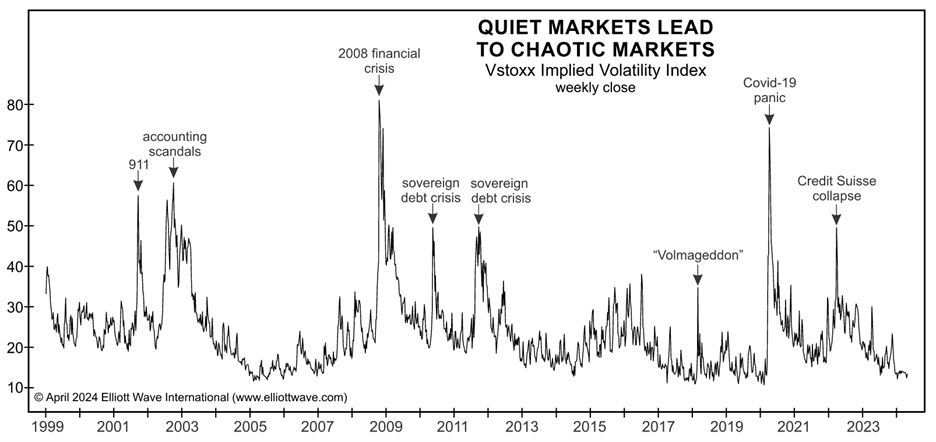
The VIX, a measure of volatility based on options premiums, has been sitting at its lowest level since May 2008, when wave (2) of ((1)) peaked out and led to a Dow loss of 50% over the next ten months. Low premiums indicate complacency among options writers. The quants who designed the trading systems that blew up in 2008 generally assumed that low volatility meant that the market was safe, so at such times they would advise hedge funds to raise their leverage multiples. But low volatility is actually the opposite, a warning that things are about to change. The fact that the options market gets things backward is a boon to speculators. Whenever options writers are selling options cheap, the market is likely to move in a big way. Combined with the readings on the Equity Put/Call Ratio, puts right now are a bargain.
In October 2008 at the bottom of wave 3 of (3) of ((1)), the Investors Intelligence poll of advisors (which has categories of bullish, bearish and neutral), reported that more than half of advisors were bearish. In December 2009, it reported only 15.6% bears. This reading was the lowest percentage since April 1987, 23 years ago! As happens going into every market top, the ratio has moderated a bit, to 18.9% bears. In 1987, the market also rallied four months past the extreme in advisor sentiment. Then it crashed. The bull/bear ratio in October 2008 was 0.4. In the past five months, it has been as high as 3.4.
The Daily Sentiment Index, a poll conducted by Trade-Futures.com, reports the percentage of traders who are bullish on the S&P. The reading has been registering highs in the 86-92% range ever since last September. Prior to recent months, the last time the DSI saw even a single day’s reading at 90% was June 2007. At the March 2009 bottom, only 2% of traders were bullish, so today’s readings make quite a contrast in a short period of time.
The Dow’s dividend yield is 2.5%. The only market tops of the past century at which this figure was lower are those of 2000 and 2007, when it was 1.4% and 2.1%, respectively. At the 1929 high, it was 2.9%.
The price/earnings ratio, using four-quarter trailing real earnings, has improved tremendously, from 122 to 23. But 23 is in the area of the peak levels of P/E throughout the 20th century. Ratios of 6 or 7 occurred at major stock market bottoms during that time. P/E was infinite during the final quarter of 2008, when E was negative. We will see quite a few quarters of infinite P/E from 2010 to 2017.
The Trading Index (TRIN) is a measure of how much volume it takes to move rising stocks vs. falling stocks on the NYSE. The 30-day moving average of daily closing TRIN readings has been sitting at 0.90, the lowest level since June 2007. This means that it has taken a lot of volume to make rising stocks go up vs. making falling stocks go down over the past 30-plus trading days. It means that buyers of rising stocks are expending more money to get the same result that sellers of declining stocks are getting. Usually long periods of low TRIN exhaust buying power.
For more market analysis and forecasts from Robert Prechter, download the rest of this 10-page issue of the Elliott Wave Theorist free from Elliott Wave International. Learn more here.
Robert Prechter, Chartered Market Technician, is the world's foremost expert on and proponent of the deflationary scenario. Prechter is the founder and CEO of Elliott Wave International, author of Wall Street best-sellers Conquer the Crash and Elliott Wave Principle and editor of The Elliott Wave Theorist monthly market letter since 1979.
Skeptics are still worried the market has come too far, too fast. EWI’s Chief Market Analyst Steve Hochberg joins CNBC Squawk Box host Joe Kernen on April 15, 2010 to share his view.
Get More Market Analysis in Steve Hochberg’s FREE 16-Page Report
You’ve bared witness to the Great Asset Mania with signs such as unsustainable government spending, overvalued stocks and fear of a so-called double dip recession. But is it over and could it rise again? What does it mean for your investments? Originally available to subscribers at $59, you can now download this 16-page report free for a limited time Learn more here.
In 1984, Elliott Wave International's founder and president Robert Prechter won the U.S. Trading Championship, setting a new all-time profit record of 444.4% in a monitored real-money options account in 4 months. In the average 4-month contest, over 75% of contestants, mostly professionals, fail to report profits.
In November 1986, in his monthly Elliott Wave Theorist Prechter published a Special Report titled, "What A Trader Really Needs To Be Successful" and gave 5 important tips to would-be market speculators. You can read them now, free (details below) — but here's Bob's fourth point:
4. Accept the Fact that Losses Are Part of the Game.
There are many denials of reality which automatically disqualify millions of people from joining the ranks of successful speculators. For instance, to moan that "pools," "manipulators," "insiders," "they," "the big boys" or "program trading" (known today as "high-frequency trading" — Ed.) are to blame for one's losses is a common fault. Anyone who utters such a conviction is doomed before he starts. But my observation, after eleven years "in the business," is that the biggest obstacle to successful speculation is the failure merely even to recognize and accept the simple fact that losses are part of the game, and that they must be accommodated.
The perfect trading system does not exist. Expecting, or even hoping for, perfection is a guarantee of failure. Speculation is akin to batting in baseball. A player hitting .300 is good. A player hitting .400 is great. But even the great player fails to hit 60% of the time! He even strikes out often. But he still earns six figures a year, because although not perfect, he has approached the best that can be achieved. You don't have to be perfect to win in the markets, either; you "merely" have to be better than almost everybody else, and that's hard enough.
Practically speaking, you must include an objective money management system when formulating your trading method in the first place. There are many ways to do it. Some methods use stops. If stops are impractical (such as with options), you may decide to risk only small amounts of total capital at a time. After all is said and done, learning to handle losses will be your greatest triumph.
The last on my list is [the point] I have never heard mentioned before. …
Read the rest of Prechter's Special Report now, free! All you need is to create a free Club EWI profile. Here's what else you'll learn:
Why a trading method is a must for your success
What part discipline plays in your trading success
How to gain trading experience
More
Keep reading this free Special Report titled, "What A Trader Really Needs To Be Successful" now — all you need to do is create a free Club EWI profile.
Elliott Wave International (EWI) is the world’s largest market forecasting firm. EWI’s 20-plus analysts provide around-the-clock forecasts of every major market in the world via the internet and proprietary web systems like Reuters and Bloomberg. EWI’s educational services include conferences, workshops, webinars, video tapes, special reports, books and one of the internet’s richest free content programs, Club EWI.
What makes stocks rise? What makes steady Employment? What makes home prices increase? Social mood is what drives the markets, the economy, politics and the culture:
Early in the game when debt levels are down, as the social mood improves in capitalist economies, people start borrowing to create a good future for themselves. They work hard, educate themselves, hopefully innovate and invent. Discoveries lead to new markets and new ways of life. This is a phase when there is room for improvement.
Due to herding, everybody looks at each other and borrows more. Because of fractional reserve banking, this borrowing inflates the money supply as banks create money out of thin air:
This early growth becomes the inflationary boom. As total debt expands, it requires more and more borrowing to service existing debt. With the recent memory of the past, people keep borrowing and investing even though science and technology may start lagging behind. Instead of true growth, a financial mania based on hope and greed takes hold. Everybody wants to get rich. But nobody wants to pay the price:
Instead of creating scientists, engineers, workers, the population rides the wave of hope and optimism with more and more real estate agents, mortgage brokers, investment bankers. The new economy is hailed as the service economy. It is a new way of life.
People make money giving haircuts to each other. They then marvel at the GDP increase they create doing that. In the darkness, a little secret looms. Everyday more of their income goes to service existing debt.
When the entire money supply is borrowed from the banks, it has principal and interest to pay back. In order to pay interest, borrowing must increase exponentially. If borrowing stops, economy stops:
If deflation is allowed, the house of cards will crash. Thus the dream must continue at all costs. To achieve this the FED lowers interest rates to attract more borrowers. The government turns a blind eye on sub-prime. No 20% down. The more you borrow, the better it is. Liar loans are ok as long as you are a home buyer (aka good citizen). Credit card companies make 0% offers to any breathing soul just so that you can write a balance transfer check and inflate the money supply. Or deflation will start.
At the end, all futile efforts give way to the simple fact: We run out of borrowers. As the expansion of money supply stops, it becomes impossible to pay existing debt (which is the money supply), with interest. Principal exists, but interest portion is not created yet.
Weakest borrowers fail to earn enough to pay the interest. They foreclose, or go bankrupt. The money to earn to pay the total debt does not exist!
FED still claims it is goldilocks economy. As the crisis gets worse, the shortage of money becomes obvious. Some banks fail. Banks who now hold toxic consumer debt are bankrupt and are kept alive by accounting rule changes. FED prints money and gives it to the banks so that they remain solvent. FED keeps printing as deflation keeps showing it’s ugly head.
Foreign creditors are disgusted at the FED’s printing press. Eventually they refuse to lend money in US dollars. This causes market rates to increase for US treasuries. FED follows with higher rates. Credit dependent industries such as housing take another hit and practically become cash down markets.
Salaries stagnate even though consumer prices may go higher due to expensive imports. Unemployment exceeds Great Depression levels. Tax rates go higher to service existing public debt. Consumer economy is wiped out. People can only afford basic necessities. Service sector suffers. As the value of the money supply falls, US becomes poorer and poorer. As the debt is wiped out first via deflation, and then via printing press, we hit the bottom.
At the bottom people see no choice but to educate themselves to create real value again. If investment in science and technology starts to match other nations, then we start the cycle all over again. If not, then we stay at the bottom with a miserable life.
What is the solution? There is no solution. This is not about what we are going to do. This is about what we have already done. An entire nation cannot borrow from the future for decades and then hope that all will be fine when the future arrives. You can only save yourself if you were lucky enough to stay out of debt. At the bottom of the kondratieff cycle, it will be the time to borrow again. We are not there yet. How do we know? Stock market tells us:
Signs of deflation are visible but the public will be fooled
Deflation requires a precondition: a major societal buildup in the extension of credit (and its flip side, the assumption of debt).
– Conquer the Crash, 2nd edition (p. 88)
Has the United States met that precondition?
Well, consider that total credit market debt as a percent of U.S. gross domestic product was
280 percent in 1929 at the start of the Great Depression
380 percent in 2008
The current build-up of credit goes far beyond major — it’s unprecedented.
It’s been rising steadily for 60 years. The slope literally looks like the side of a steep mountain.
Bank credit and Elliott wave expert Hamilton Bolton studied every major depression in the U.S. In 1957, he made this observation:
All were set off by a deflation of excess credit. This was the one factor in common…the signs were visible many months, and in some cases years, in advance. None was ever quite like the last, so that the public was always fooled thereby.
Let’s read again from the second edition of Conquer the Crash (p.92):
A deflationary crash is characterized in part by a persistent, sustained, deep, general decline in people’s desire and ability to lend and borrow…
The U.S. has experienced two major deflationary depressions, which lasted from 1835 to 1842 and from 1929 to 1932 respectively. Each one followed a period of substantial credit expansion. Credit expansion schemes have always ended in bust. The credit expansion scheme fostered by worldwide central banking…is the greatest ever…If my outlook is correct, the deflationary crash that lies ahead will be even bigger than the two largest such episodes of the past 200 years.
Is there evidence now that a deflationary trend is underway? Dear reader, the evidence is abundant and growing by the day.
To begin with, just a casual observation of our national economic life reveals a deep general decline in people’s desire and ability to lend and borrow.
But there are many specific signs pointing to bankruptcy, default and a deflationary spiral.
Yet they’re not grabbing the headlines. The “good” economic reports and levitating stock market are. The public will likely be fooled again. But make no mistake, the signs are there.
Learn Why Deflation Is the Biggest Threat to Your Money Right Now
Discover Robert Prechter’s views on the unfolding deflationary trend by reading the 90-page report, The Guide to Understanding Deflation. This guide will help you survive a major deflationary trend, and even equip you to prosper.
Most people are confident they can recognize a myth when they hear one: Wearing a hat causes baldness; eating a bunch of carrots gives you perfect vision; 'light' cigarettes are better for your health than the regular kind.
But what about this sentence: Inflation is the number one threat to the US economy? Ask the mainstream experts, and this statement is in no way a fabrication of the truth; it is truth itself. Case in point, this recent insight from a reputable news source:
"Given the extraordinary amounts of government spending, we believe inflation is likely to rear its ugly head." (CNBC)
It looks reliable. It sounds reliable. But the reality is different. That fact is the subject of Chapter Three in Club EWI's free educational eBook Market Myths Exposed, aptly titled "Myth No. 3: Worry About Inflation Rather Than Deflation."
With groundbreaking insight from EWI's president Bob Prechter, this chapter reveals how the most vital financial players have been led right up to the water of easy money. Yet, like the saying goes, no amount of incentive — be it record low interest rates or trillions of dollars in federal bailouts — has gotten them to "drink." Here, the "Market Myths" chapter sheds light on this global leverage fast:
Banks: The premier dispensers of credit are about "95% invested in mortgages," which can fall in dollar value at the start of a crisis. Also, a chart of Credit Standards At All Banks since 1997 reveals a new trend of tighter lending criterion. Both are deflationary.
Consumers: The premier devourers of credit are paying off their balances. See: chart of Total Consumer Credit (Annual Rate of Change) since 2000. This is deflationary.
Private Equity:"Of the ten largest leveraged buyout deals since 2007, four have defaulted and two are in distress. Just in this small group, there is nearly one-half a trillion dollars worth of loans headed for the dump."
Small Businesses are self-liquidating; meaning, they create profits to pay back loans versus consumers. YET, "Market Myths" Chart of Bank Loan Availability to these small Enterprises contains a big, black arrow pointing DOWN. This is deflationary.
Home owners: Real estate values continue to fall, foreclosures continue to soar. Mortgage delinquencies are rising, and more and more people are walking away from their properties. All of these conditions are deflationary.
Six pages of riveting charts and commentary later and there's no putting the pieces of this shattered myth back together: One by one, the key players in the creation and expansion of credit are adopting a stance of conservation and conservatism. This ultimately leads to a decline in the value of outstanding debt — a precondition of deflation, not inflation.
Believe it or not, this is just the beginning. In all, Market Myths Exposed throws light on the TEN most common financial misconceptions via excerpts and charts from EWI's most popular editorial material of the last decade. Such as:
Myth No. 1: Earnings Drive Stock Prices
Myth No. 5: To Do Well In Investing, You Have To Diversify